Cybersecurity for Small Business vs. Enterprise Security: What Protection Do You Really Need?
There is one difficult truth that many small business owners have to accept. If you run a small company that believes hackers will target Facebook and Google and leave your business alone because it is too small and not on anyone’s radar, then you are most probably wrong. Security for small business differs significantly from enterprise security in terms of both requirements and resources.
Even the biggest companies cannot afford to have their safety measures compromised, but for them, the problem is manageable. On average, organizations of the Fortune 500 list need 4.88 million dollars to deal with an incident of data breach (as cited in Cost of a Data Breach Report, IBM 2024). Most small businesses do not have such capabilities. For this type of company, the task is more challenging, as it should consider their resources and focus on things that are truly important.
Table of Contents
Why Cybersecurity for Small Business Looks Nothing Like Enterprise Security
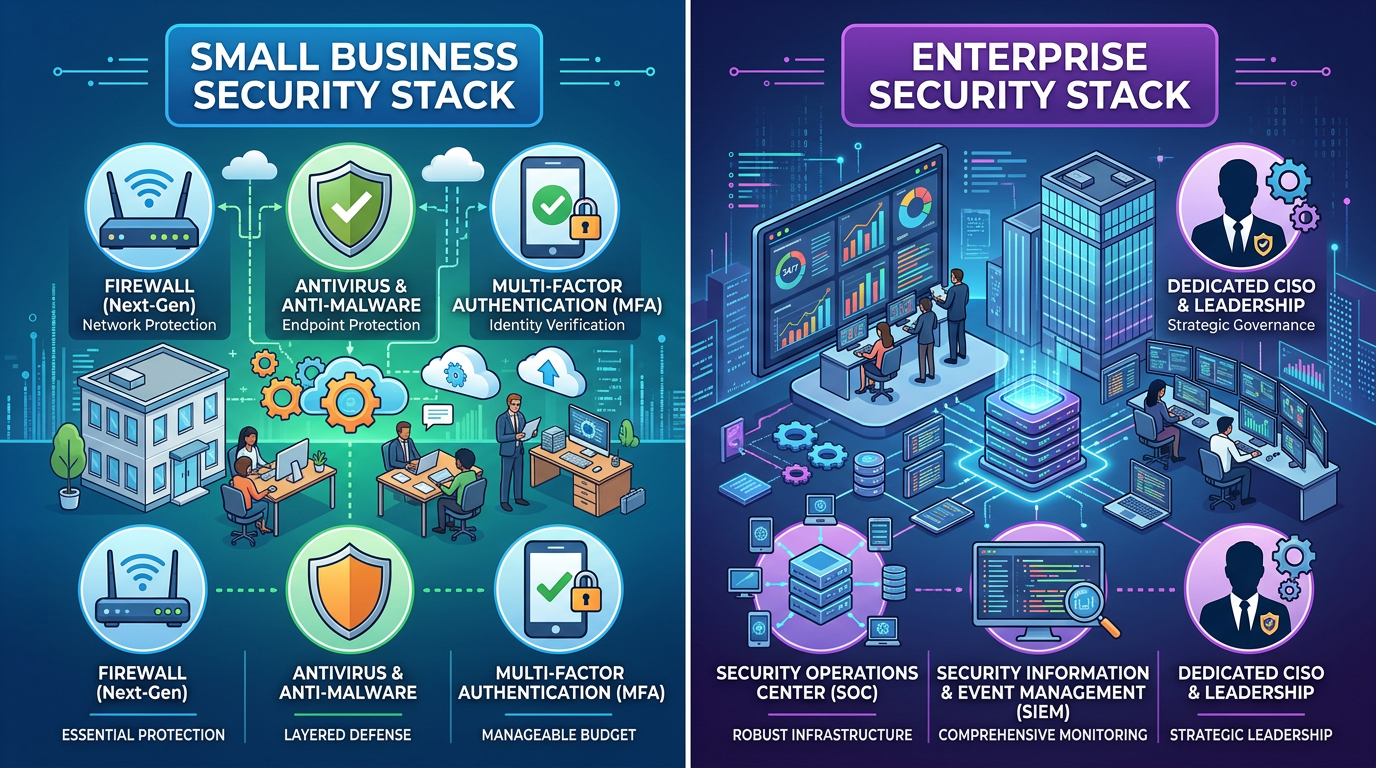
Think of enterprise security as a fully-fledged military base with a permanent garrison, and small business security as a house with a secure lock and a good alarm system. Both have to protect against the same threats, but with dramatically different resources and approaches.
The Budget Gap That Makes All the Difference
While enterprises have the budget to invest in dedicated security operations centers, small businesses often have to make do with an “IT department” consisting of a single person or an outsourced contractor. This isn’t an indictment of small business practices – it’s simply a fact of organizational structures. As reported by multiple cybersecurity research institutes (Accenture, Verizon), about 43% of all cyberattacks target small businesses and this trend appears to be growing. In fact, according to Verizon’s 2025 Data Breach Investigations Report , small and mid-sized businesses experienced four times as many data breaches as large organizations in the last year alone.
The Attack Surface That Comes With Size
Here’s an insight that many small business owners find counterintuitive – the smaller your business is, the more attractive it is to attackers. While enterprises become high-profile targets, small businesses with limited security measures (or no dedicated security staff) present an easier prize. This is why small businesses tend to be targeted more often by attacks that exploit known vulnerabilities or use phishing techniques.
The Real Risks: What Attacks Actually Target Small Businesses
You can’t build the right defense without knowing what you’re defending against. And when it comes to small business computing environments, there’s a particular attack pattern that stands out
Phishing and Ransomware: The SMB One-Two Punch
Phishing attacks continue to be the favored initial attack vector against small businesses, comprising approximately 34% of SMB breaches in 2025 according to Heimdal Security research. This is followed by ransomware introduction with an astonishing 88% of SMB breaches in Verizon 2025 DBIR including a ransomware element compared to only 39% of enterprise breaches. The ransomware component may be added immediately after phishing or through other means, but the combination of the two is significantly more damaging to business operations with ransomware payments being 3x higher for SMBs.
Supply Chain and Third-Party Risk
This is a challenge that enterprise security teams deal with on a daily basis while many SMB security professionals don’t have any understanding of it at all. If you’re using any third-party service or product, they have access to your network and systems equivalent to your own employees. Larger companies now require third-party vendors to complete security questionnaires and provide SOC 2 or other compliance documentation as part of due diligence. This is becoming more common for small businesses as well where vendors expect to be asked about their security practices.
Common small business vulnerabilities include:
- Insufficient or shared passwords for all business applications
- No multifactor authentication for email and financial systems
- Systems with unpatched software and outdated operating systems
- Personal device use with no endpoint protections in place
- No incident response planning capability (most SMBs make it up as they go)
Core Cybersecurity for Small Business: What You Actually Need
Let’s discuss budget. For enterprise-level cybersecurity, you need both an enterprise-level budget and the correct priorities.
The Essentials
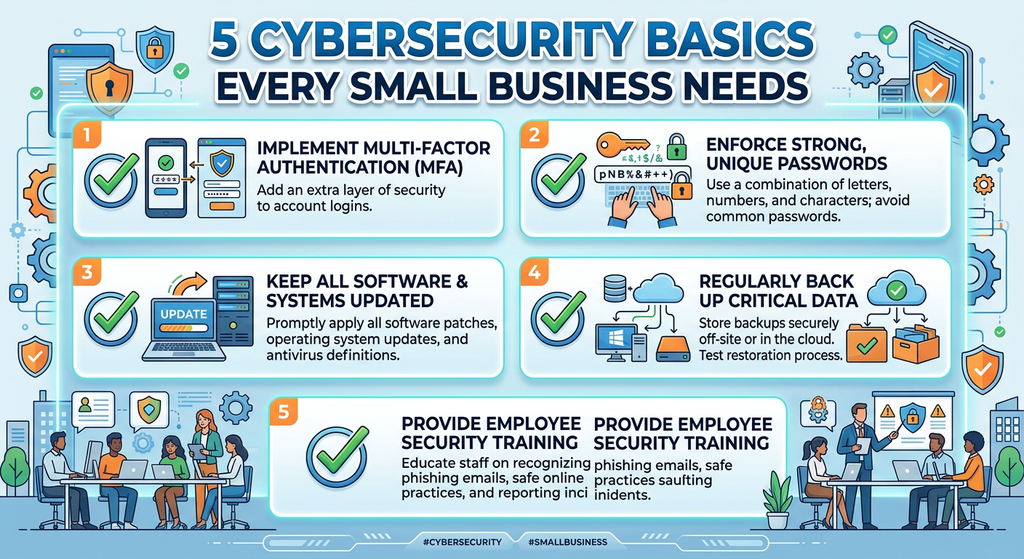
These are the absolute minimums, regardless of your situation:
- Every business email account (including any financial or administrative account) should have multi-factor authentication. (Yes, even if they’re not officially ‘enterprise’ accounts)
- Regular automated backups of your data, preferably isolated from your main network. (Your life insurance against ransomware attacks)
- All devices touching company data need some form of endpoint protection software
- Security training for your staff
- A documented, regularly tested incident response plan (preferably more than a single page)
When Does Compliance Software Stop Being a Want and Start Being a Need?
There are two primary reasons that compliance software for small business becomes a necessity rather than an option: customer data needs and enterprise customer requirements. If you handle customer payments or healthcare data in any capacity, or have enterprise customers requiring you to prove a certain standard of security, then you’re likely to need to invest in compliance software for small business at some point. Standards such as PCIDSS, HIPAA, SOC2, and GDPR compliance requirements for enterprise vendors make this a downstream requirement for many small businesses.
Automated Compliance Management Or Excel Sheets?
This is the big one, the point where many small businesses enter the conversation. Compliance management software does exactly what it sounds like it should – it tracks your compliance with various security standards, finding gaps in your defenses and generating the appropriate documentation for you to present to auditors. It’s significantly more effective than the usual process of taking screenshots of relevant pages and pasting them into a spreadsheet for an annual PCI audit. The tools we’re looking at (Vanta, Drata, Secureframe, and others) started out as solutions for small businesses with enterprise customer requirements, but many offer a clear entry-level option for small businesses without those requirements.
If you’re looking to start using compliance management tools but aren’t sure which ones fit your specific situation, I’d recommend reading this guide from Moneticks . It provides a detailed breakdown of the tools mentioned above in this section, comparing their features and cost options.
Enterprise Security: What Big Companies Do Differently (And What SMBs Should Borrow)
Enterprise security is not only about buying more of the same tools. It is also a different operating philosophy.
Dedicated SOC and Threat Intelligence
Large enterprises typically have Security Operations Center (SOC) dedicated to continuous monitoring and analysis of security events, either as an in-house team or outsourced. Large enterprises often have the resources to justify a 24×7 SOC operation, which produces numerous alerts that get investigated using Security Information and Event Management (SIEM) systems. While you can’t justify a SOC team for your small business, there are managed detection and response (MDR) services that provide similar benefits as a SOC team, but for a much lower price (around several hundred USD per month).
GRC Software and Frameworks (SOC 2, ISO 27001, NIST)
The security-related activities of enterprise-class organizations are governed by a set of standards, regulations, and laws. These are implemented via Governance, Risk, and Compliance (GRC) software that maps controls to standards such as ISO 27001, SOC 2, ISO 27001, or NIST Cybersecurity Framework. Surprisingly, the National Institute of Standards and Technology (NIST), published a “Small Business Cybersecurity Corner” website, dedicated to the needs of small businesses.
It actually notes that small businesses do not have the resources to implement all enterprise controls. The recommended approach is to cherry-pick based on the threat model of the enterprise. Taking that further, having a subset of controls that are formally defined (but at a lower scale) could be a good selling point when targeting larger clients.
Choosing the Right Protection: A Practical Framework for Small Business Owners
So — how much should you actually spend, and on what?
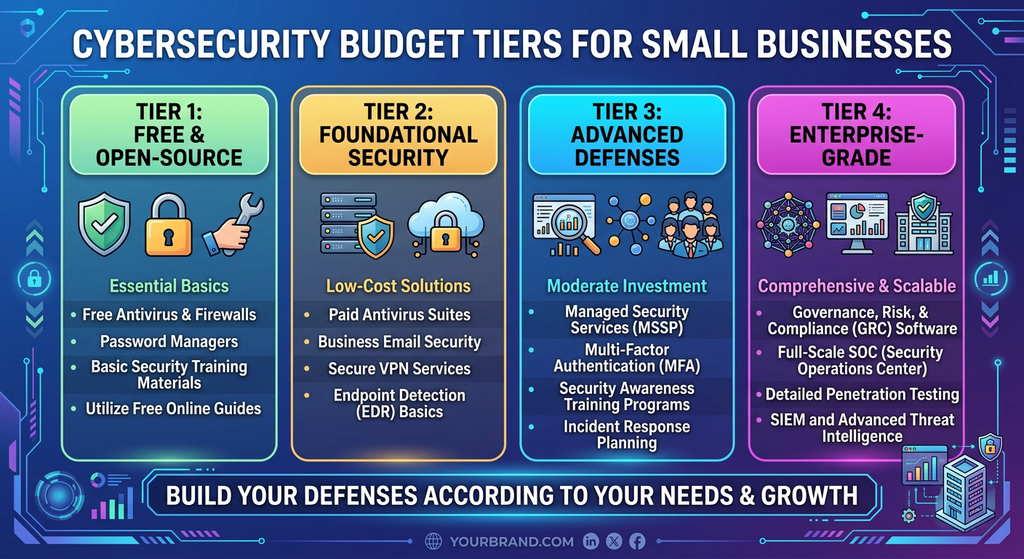
Budget Tiers: What Different Investment Levels Buy You
| Monthly Budget | What You Get |
|---|---|
| $0–$100 | Free antivirus, built-in MFA, basic employee training videos, cloud backup |
| $100–$1,000 | Managed antivirus/EDR, email security filtering, basic compliance software, password manager for teams |
| $1,000–$5,000 | MDR services, automated compliance management platform, cyber insurance, penetration testing (annual) |
| $5,000+ | Fractional CISO, GRC software suite, continuous compliance monitoring, dedicated incident response retainer |
Signs That You’ve Grown Beyond Basic Tools
You’re ready for more advanced security tools if:
- You’re handling significant amounts of customer payment or health information
- Enterprise customers are requiring you to have certain security certifications to work with them
- Any type of incident almost occurred (phishing link clicked, questionable login attempt)
- You’ve scaled beyond 15-20 people with different levels of access
The biggest mistake small business owners make? Not the budget, it’s the allocation. Buying expensive firewalls while ignoring multifactor authentication is like buying cameras for your doors, but leaving the windows wide open.
Conclusion
Cybersecurity for small business: what it takes to stay safe without blowing your budget
Cybersecurity for small businesses is a tricky subject. The security needs of these companies are different from the needs of enterprises. Small companies cannot afford to invest heavily in security solutions. At the same time, such organizations are the target of many cybercriminals. This is an unacceptable risk for any company, regardless of its size. Fortunately, there are several fundamental security measures that can protect a small business from external threats.
They include multifactor authentication, backups, endpoint security, employee training, and compliance software. Small businesses can enhance their security further by studying more sophisticated security solutions. With time, increased IT maturity will allow the organization to shift towards more advanced and capital-intensive security solutions. The security needs of enterprises are different from the needs of small businesses. Organizations that have entered the enterprise category (or aim to enter it) should consider the security measures described above. The implementation of these solutions will allow the enterprise to demonstrate to its large clients that the company has robust security measures in place.
Frequently Asked Questions
1. Does cybersecurity for small business differ from that of enterprises, or is it just scaled down and cheaper?
Cybersecurity for enterprises requires much more complex and multi-tier solutions that are powered by dedicated specialists. At the same time, small business security solutions prioritize different means and practices that cannot be supported by limited resources. For example, small enterprises do not have the personnel to provide round-the-clock system and network monitoring, so they have to rely on tools providing greater automation.
2. How much should a business owner or small enterprise spend on cybersecurity solutions per year?
Most experts suggest allocating 3 – 7% of the annual IT budget for cybersecurity solutions, depending on the area of operation. For instance, small businesses handling critical health-related data should consider investing more in cybersecurity solutions right away, such as compliance software.
3. Do small businesses need compliance software or is it meant for enterprises and larger organizations?
If an organization processes payments or personal health data or works with other high-profile clients, it needs to invest in compliance solutions right away. Such software can prevent spending much more on regulatory fines and help enter the market. It is not only for enterprises as even small businesses can afford it, and it can help them much faster than preparing reports for each audit.
4. What is the best cybersecurity investment a small business can make in its current situation?
Multi-factor authentication is the most critical security investment a small business can make. MFA is available in most software and systems, often free of charge or at a low cost, and is quick and easy to set up. At the same time, it considerably improves security by protecting against the most common threat – credential theft. It helps especially when dealing with regular email compromise attempts, which are the most common type of cybercrime.
5. Can a small business get cyber insurance?
Does it eliminate the need for other forms of protection? Most small businesses can purchase cyber insurance, and it is often a wise investment. However, keep in mind that most insurers will only offer coverage if the appropriate security measures are in place, such as MFA, various forms of data and system protection, and similar tools. Therefore, cyber insurance may cover some of the expenses but not all, and small businesses should still invest in data and network protection.