
Compliance Management Systems: 10 Best Software Solutions for 2026
There is a shocking figure that most U.S. businesses are unaware of — companies spent an estimated $272 billion on compliance activities in the United States in 2024, according to the Competitive Enterprise Institute’s annual cost-of-regulation report. This does not even include the financial risk of getting it wrong. Whether it’s HIPAA, SOC 2, ISO 27001, GDPR, CCPA, or FTC guidelines — regulations touch everything from how you store and secure your customer’s data to how you train your employees to manage data internally.
Modern compliance management software makes it simple to centralize your policies, automate your evidence collection, identify weaknesses before the auditors do, and give leadership an overview of risk. In this guide, we’ve selected the 10 best compliance management software solutions for 2026 — with in-depth detail on what kind of organization would benefit from their tools.
Table of Contents
What is a Compliance Management System — and Why Do You Need One in 2026?
A compliance management system (CMS) is a software program designed to manage and report on an organization’s adherence to standards and regulations. CMS is the command center for an organization’s compliance program — think of it as an evolution of the policy binders and Excel spreadsheets sitting in filing cabinets across your office. But in 2026, the stakes of non-compliance have risen to new heights.
The Cost of Non-Compliance in the U.S.
The numbers say it all:
The average cost of a data breach in the U.S. hit $9.36 million in 2024 — the highest cost of any country globally, according to IBM’s Cost of a Data Breach Report 2024 HIPAA penalties can include up to $1.9 million per violation category per year The FTC has ramped up enforcement actions in 2024–2025 around enhanced data privacy rules SOC 2 audit failures can kill enterprise SaaS sales Regulatory non-compliance is not just a legal issue — it is a revenue issue.
What a Modern Compliance Management Software Can Do For You
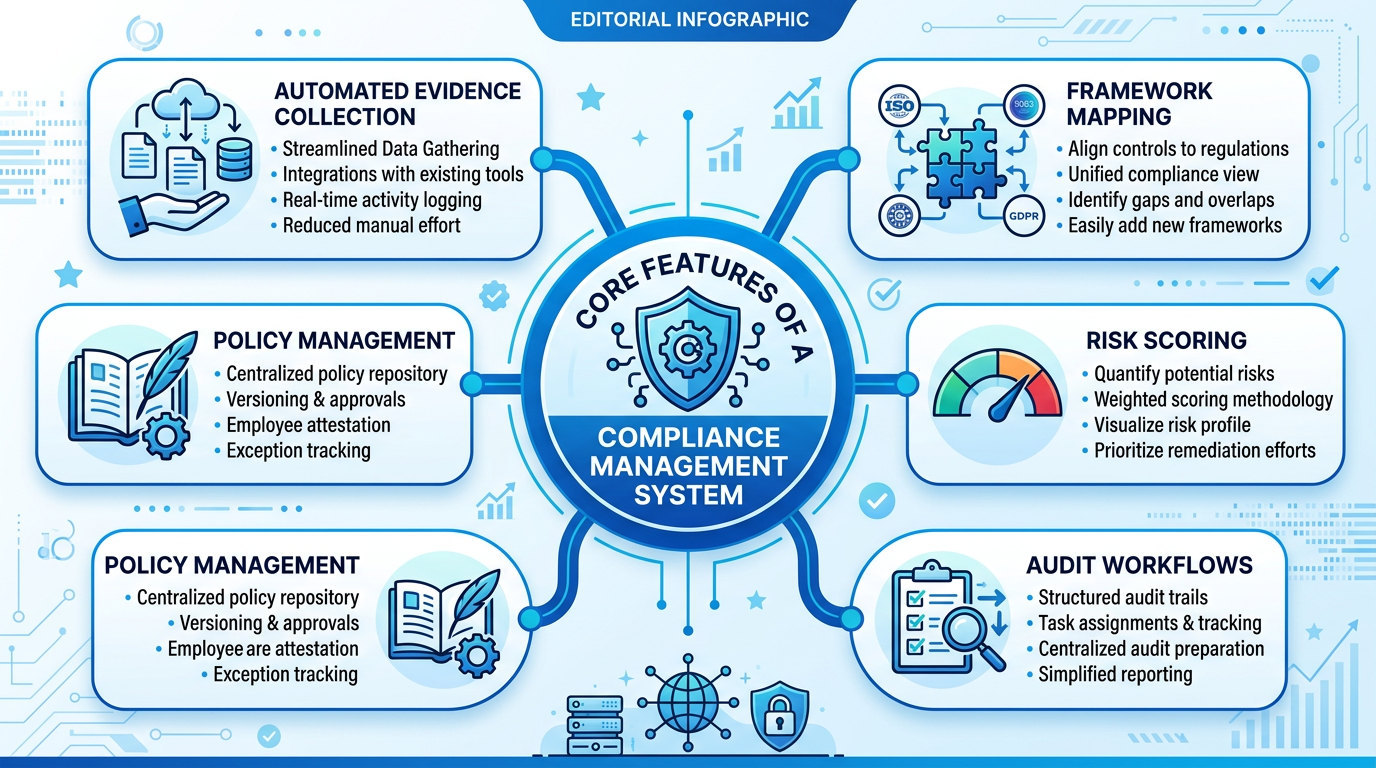
Modern CMS products offer a wide range of features, not least of which include:
Evidence collection that integrates with your cloud infrastructure (AWS, Azure, Google Cloud).
Framework mapping that shows how a single control satisfies multiple compliance standards.
Risk-scoring and heatmaps to show the board what matters most.
Audit-ready control procedures that have built-in task assignments and due dates.
Policy management along with the version control and also the employee acknowledgment tracking.
Vendor and third-party risk management modules.
Tools to integrate with Jira, Slack, GitHub, Okta, Google Workspace, and other tools.
How To Choose the Best Compliance Management Software for Your Needs
It is not enough to simply compare the superficial features of one CMS product to another. The CMS that is right for a mid-sized SaaS startup undergoing their first SOC 2 audit bears little resemblance to the CMS needs of a 5,000-person healthcare organization that has to juggle HIPAA, HITECH, and the state-specific privacy laws of every U.S. state they operate in.
Our breakdown of management reporting software: pricing, features, and ROI compared is a useful companion read if your leadership team needs visibility dashboards that go beyond what the compliance tool itself provides
Key Features to Evaluate
When choosing a CMS solution, consider the following: Frameworks: Does the CMS tool support the frameworks relevant to your business? SOC 2, ISO 27001, HIPAA, PCI DSS, NIST, GDPR, CCPA, FedRAMP?
Automation: Does the CMS automatically collect evidence from your IT infrastructure and applications, or do users have to upload information manually?
Multi-framework mapping: Can controls satisfy requirements for multiple frameworks, or are you managing them separately?
UX: Will your non-technical users actually use this software, or will buy it and then let it gather digital dust on a company server?
Audit-friendly: Can auditors access the CMS in real-time, or do you have to export PDF reports for them?
Scalability: Can the CMS grow with your business, or do you have to migrate to a different system?
Integrations: Does the CMS integrate with the tools your team uses daily? Cost: Is the CMS priced based on users, frameworks, or a flat-fee?
Questions to Ask Before Signing the Contract
Who owns the data if we cancel the subscription?
How long is the implementation timeline, and what kind of support is included?
Can we run through a sample audit using the CMS?
What is the average audit-readiness timeline for organizations similar to ours?
Does the CMS stay up to date with changing regulations?
For compliance and risk software, the Gartner GRC Market Guide and Forrester’s Wave reports on GRC platforms are two of the most authoritative independent analyst resources for enterprise buyers.
The 10 Best Compliance Management Systems for 2026
1. LogicGate Risk Cloud
Best for: GRC for mid-market to enterprise organizations.
What is it: LogicGate Risk Cloud is a customizable GRC (Governance, Risk, and Compliance) platform ideal for companies with complex, interconnected risk and compliance programs that span across departments and require a high degree of customization without requiring heavy lifting from developers.
Standout features: No-code workflow builder for custom compliance needs.
Cross-functional risk correlation.
Enterprise-grade integration with ServiceNow, Salesforce, Jira, etc.
Strong audit trail/reporting.
Who it’s best for: Financial services, healthcare, and technology companies with dedicated compliance teams.
2. Workiva
Best for: Public companies and regulated financial reporting.
What is it: Workiva is actually a connected compliance and reporting platform, best known for helping public companies manage SEC filings and ESG reporting. Unlike other CMS products, Workiva combines financial reporting, ESG disclosure, and regulatory compliance into one collaborative environment.
Standout features: XBRL tagging for SEC filings.
ESG and sustainability reporting frameworks.
Linked data that updates across all reports when source data changes.
Who it’s best for: More than 6,000 organizations, including public companies and Fortune 500 firms.
3. ServiceNow GRC
Best for: Large enterprises using the ServiceNow platform.
What is it: ServiceNow GRC is the compliance component of ServiceNow’s larger IT operations platform. If you’re using ServiceNow for your IT service management, then ServiceNow GRC gives you a powerful compliance environment where risk data can be correlated directly to IT assets and incidents.
Standout features: Deep IT risk and control integration.
AI-driven risk assessments.
Policy and compliance management for global regulations.
Strong vendor risk management
Consideration: Requires significant investment in implementation; best for enterprises with mature IT and compliance operations.
4. Hyperproof
Best for: SaaS companies and tech startups needing to manage multiple frameworks.
What is it: Hyperproof is designed for companies that need to manage multiple compliance frameworks at once. Their native control mapping and cloud integrations make them a popular choice with SaaS organizations looking to achieve SOC 2, ISO 27001, and HIPAA simultaneously.
Standout features: 70++ frameworks out-of-the-box.
Automated evidence collection from 70+ cloud vendors.
Cross-framework control mapping.
Compliance operations dashboard.
Pricing: On request — scales with number of users/frameworks.
5. AuditBoard
Best for: Internal audit teams and SOX compliance
What is it: AuditBoard enjoys an excellent reputation in the internal audit space, particularly for its SOX compliance tools for public companies. While SOX has long been their calling card, they’ve since expanded their platform to include more general risk and compliance management with a strong audit-focused workflow.
Standout features:
SOX control testing and deficiency tracking
Risk-based audit planning
Integrated issue management
Real-time dashboards for executives
Who it’s best for: Public companies, pre-IPO organizations, and enterprises with mature internal audit functions.
6. Drata
Best for: Startups needing automation for SOC 2 and ISO 27001
What is it: Drata has carved out quite a niche for themselves in the crowded CMS space by being one of the few companies that provide end-to-end automated SOC 2 compliance. Their strength lies in helping start-ups achieve SOC 2 compliance with minimal friction by tying SOC 2 controls directly to your cloud infrastructure.
Standout features:
85+ native integrations including AWS, GitHub, Okta, Google Workspace
Continuous automated control monitoring
Customizable security questionnaire responses (AI-powered)
Compliance success manager included
Best for: Startups and scale-ups in SaaS, fintech, and healthtech looking to build credibility with enterprise customers.
7. Vanta
Best for: Startups and SMBs with quick compliance timelines.
What is it: Vanta is Drata’s main competitor in the startup space — and their cutthroat competition has led to a rapid innovation cycle in CMS tools for startups. Vanta’s biggest selling point is their ease of use — companies can often prepare for their first SOC 2 audit in weeks instead of months.
Standout features:
Automated evidence collection across 200+ integrations
Pre-built audit packages for major compliance frameworks
Vanta Trust Reports (security documentation for prospects) HIPAA, PCI DSS, GDPR, ISO 27001, plus SOC 2
Consideration: Some GRC features found in enterprise CMS products are still being developed for Vanta
8. Resolver
Best for: Risk management with a compliance overlay.
What is it: Resolver is all about risk management and compliance management systems in this guide fall under their “controls” category. By focusing on risk, they enable organizations to see the impact of non-compliance on business objectives and better prioritize limited resources.
Standout features:
Incident management with controls
Operational risk quantification
Compliance obligation library with regulatory updates
Powerful visualization tools
9. Sprinto
Best for: Global startups needing multi-jurisdiction compliance.
What is it: Sprinto is a compliance automation platform being used by more and more international SaaS companies to manage both U.S. and E.U.-based regulations simultaneously. Their entity-level approach is particularly helpful for organizations with subsidiaries or employees in multiple jurisdictions.
Standout features:
Supports SOC 2, ISO 27001, GDPR, HIPAA, SOC 3
Automated risk assessments and control testing
Auditor collaboration portal
Integrations with 200+ tools including Rippling, BambooHR, AWS
10. StandardFusion
Best for: Deep ISO and framework customization.
What is it: StandardFusion is a GRC platform with particular strengths in ISO framework management. They enable organizations to follow their frameworks (like ISO 27001, ISO 9001, ISO 22301) with a greater degree of customization than most CMS products on the market.
Standout features: Native ISO framework templates with clause guidance
Risk register with qualitative/quantitative scoring
Supplier and vendor risk management
Custom reporting for executives
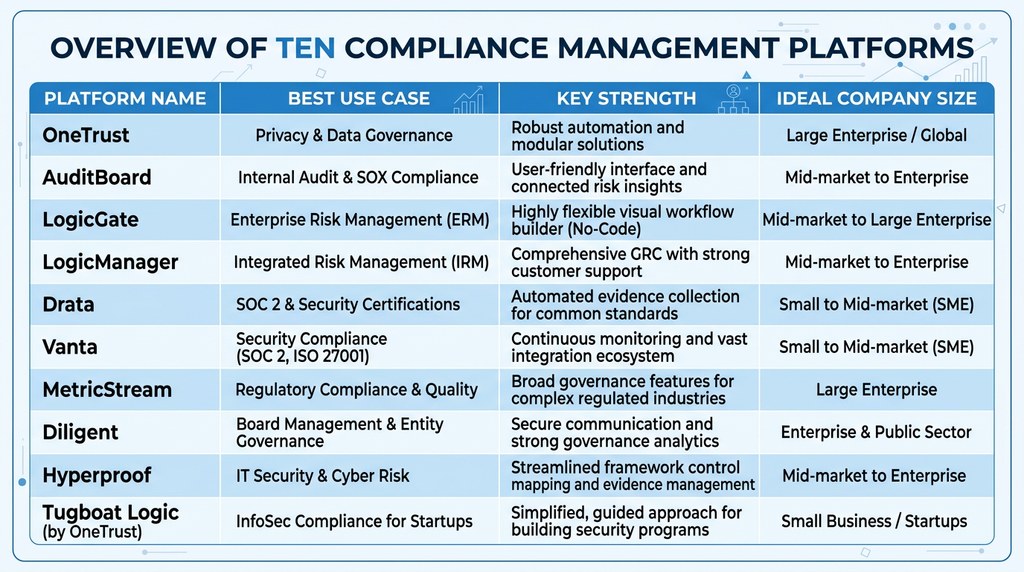
Compliance Management Software Comparison at a Glance
| Platform | Best For | Key Strength | Pricing Model |
|---|---|---|---|
| LogicGate Risk Cloud | Mid-market/Enterprise GRC | Custom no-code workflows | Quote-based |
| Workiva | Public companies / ESG | Financial + compliance reporting | Quote-based |
| ServiceNow GRC | Large enterprise IT-integrated | IT + risk + compliance unified | Quote-based |
| Hyperproof | Multi-framework SaaS teams | 70+ framework automation | Quote-based |
| AuditBoard | SOX / Internal Audit | Audit workflow depth | Quote-based |
| Drata | SaaS startups (SOC 2 focus) | Continuous control monitoring | Tiered / Quote |
| Vanta | SMBs needing fast compliance | Speed-to-audit-readiness | Tiered / Quote |
| Resolver | Risk-first compliance | Risk-to-compliance mapping | Quote-based |
| Sprinto | Global multi-jurisdiction SaaS | Multi-framework + global ops | Tiered / Quote |
| StandardFusion | ISO-focused organizations | ISO framework depth | Tiered / Quote |
Special Considerations: Compliance Software For Small Businesses
Most compliance software is positioned towards mid-market or enterprise buyers – and reasonably so. But if you’re a small business or start-up, keep the following in mind:
Do not try to do SOC 2, HIPAA and ISO 27001 concurrently (or even in parallel) when you have a five person team. Pick one framework that your customers are asking about and get excellent at it.
Seek out products that have guided onboarding. Vanta, Drata and Sprinto all have playbooks for small businesses that lack dedicated compliance teams.
Look for products that have straightforward, tiered pricing. Avoid products that are completely quote-based at the small-business level – they almost always price you out of the market.
Prioritize integrations over features. Something that automatically gathers evidence from your existing GitHub, Okta and AWS stack will save you an order of magnitude more time than something that requires you to manually upload your evidence.
Think about the audit partner network. Drata and Vanta both have networks of auditors who are familiar with their platform, meaning you pay less for first-time audits.
Conclusion
Compliance management systems have crossed from ‘icing on the cake’ to ‘commercial imperative’ for U.S.-based companies in regulated industries or those targeting enterprise sales. The right platform helps with more than just audit defense – it expedites sales, reduces breach risk, and provides executives with visibility into their risk profile.
For enterprises, ServiceNow GRC, LogicGate and AuditBoard offer the ability to tie together disparate compliance programs under one framework, while Drata, Vanta and Hyperproof provide start-up SaaS companies with the automation necessary to achieve ongoing compliance. For companies with more stringent ISO requirements or widespread international operations, Sprinto and StandardFusion give the depth and breadth needed for multi-jurisdictional operations.
The worst decision a compliance officer can make in 2026 is the same one they could have made in 2016 – waiting until after a breach, failed audit or enterprise sales deal has evaporated to invest in compliance management software.
1. What is the difference between a compliance management system and GRC software?
There is no uniform definition of what constitutes a compliance management system, and the terms “compliance management” and “GRC” (governance risk compliance) have overlapping but different meanings. A GRC platform covers governance, risk management, and compliance management in a single integrated solution. Compliance management systems and software, on the other hand, are more focused on regulatory control management and audit evidence collection than enterprise risk management. In practice, most platforms offer both GRC and compliance management tools. When choosing between compliance management systems and GRC platforms, focus on your organization’s specific needs: if you need to manage interconnected risk programs across departments, choose a GRC platform; if you only need to achieve specific certifications, a compliance management system will suffice.
How much does compliance management software cost for a small business?
It depends: most platforms have a minimum price per organization
2. How much does compliance management software cost for a small business?
It depends: most platforms have a minimum price per organization per year that starts from around $7500 for a single standard compliance framework. Here is a rough estimate of what a small business (with fewer than 50 employees) can expect to pay for compliance management software: • Entry-level plans: $7500 – $15000 per framework per year (Vanta, Sprinto) • Mid-market plans: $20000 – $50000+ per year for multiple frameworks • Enterprise-level plans: $50000+ per year for GRC platforms (ServiceNow, LogicGate) Most providers do not publish their pricing openly, and this list is by no means exhaustive: ask your preferred platform to provide you with a custom quote. Some platforms (Vanta, Drata) offer substantial discounts to small businesses and startups.
3. Can compliance management software replace a compliance officer?
No, and any ethical vendor would explain that to you. Compliance management software helps collect and organize evidence but does not make decisions based on that information. A compliance officer must always review collected information and analyze it in context before making any recommendations, as there are always nuances that require a human touch. This is especially true for companies that operate under highly regulated frameworks such as HIPAA, SOX, or need to maintain excellent relationships with regulatory agencies: such organizations would benefit from having a professional compliance officer even if they have automated evidence collection tools.
4. How long does it take to set up a compliance management system?
It depends on the platform and the readiness of the organization, but here is a rough breakdown:
Setup: 1 – 4 months
SOC 2 Type I audit readiness: 2 – 4 months after setup
Overall timeline: 2 – 6 months for mid-market platforms (Hyperproof, AuditBoard), 6 – 18+ months for enterprise-level platforms (ServiceNow, LogicGate)
Note that the time needed to organize internal processes and documentation is the single largest determinant of how long it will take to achieve compliance.
5. Which standards should a SaaS company be compliant with in the U.S.?
That depends on the data the company stores and processes on behalf of its customers, but here is a general guideline for SaaS companies in the U.S. in 2026:
SOC 2 Type II is the bare minimum for most B2B SaaS providers as enterprise buyers will always ask for it
ISO 27001 becomes relevant if the company has enterprise customers in Europe or other jurisdictions
HIPAA is mandatory if the company processes any protected health information
PCI DSS standards apply to companies that process, store, or transmit credit card data
GDPR and CCPA apply to companies that process personal data of EU or California residents respectively
Most platforms offer multi-standard compliance management tools, and building controls around one standard (usually SOC 2) will make achieving compliance with others easier, as some controls are similar or identical.



Pingback: 10 Best Wealth Management Software Solutions for Financial Advisors in 2026 - MONETICKS
Pingback: 7 Signs You Need Employee Management Software for Small Business (Not Just Spreadsheets) - MONETICKS
Pingback: Best HR Software for Small Business: Free vs Paid — Which One Actually Saves You Money? - MONETICKS
Pingback: Cybersecurity Solutions for Small Business Owners Who Think They're Too Small to Be Hacked - MONETICKS
Pingback: Integrating AI-Powered Employee Performance Management Software with Slack & Microsoft Teams (USA Focus) - MONETICKS
Pingback: Get SOC 2 Certification in 2026: Step-by-Step Process, Cost & Timeline - MONETICKS
Pingback: 10 Best Employer of Record Services in the USA for 2026: Pricing, Features & Reviews - MONETICKS
Pingback: Cybersecurity for Small Business vs. Enterprise Security: What Protection Do You Really Need? - MONETICKS
Pingback: Regulatory Compliance Software: Can AI Automatically Track Every Regulatory Change That Affects Your Business in 2026? - MONETICKS