
Google Ad Marketing Agency vs AI: Who Can Cut Your Wasted Ad Spend in 2026?
Let’s face it: at some point in your life, while calculating Google Ads, you might have got curious about where all your money went down the drain. A shocking amount of spent budgets get lost in keyword research, targeting, unproductive clicks. The eternal dilemma for a small business in 2026 is to choose between Google Ad Marketing Agency or an AI-driven approach.
Having seen dozens of cases where both options were applied, I can assert that there is no black and white answer; it’s more like a cloudy gray picture with plenty of nuances. So, let me try to explain why hiring a Google Ads Marketing Agency might be a better option for your business in 2026.

The Wasted Ad Spend Problem — Why It’s Getting Worse in 2026
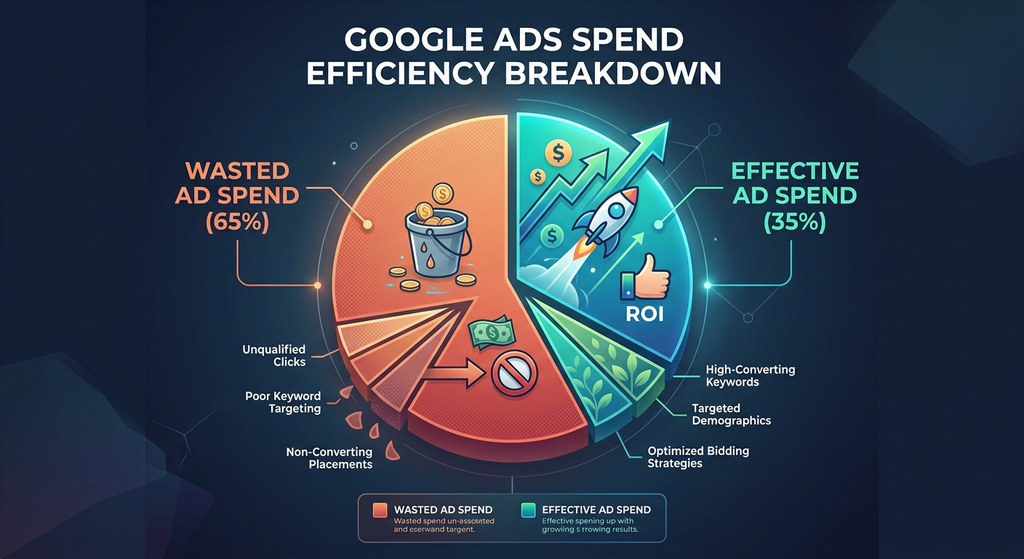
Wasted ad spend is a very real concept. It refers to the amount of money that goes directly from your pockets to the advertising platform’s pockets each time irrelevant advertising campaigns run. And in 2026, with CPC rates spiking across nearly all industries, there is an even greater danger than ever.
How Much Money Are Businesses Actually Losing?
Industry benchmarks from resources such as WordStream and Search Engine Land regularly cite 20-30% of average PPC budgets being wasted on irrelevant clicks, low Quality Score keywords, or misallocated audiences. This represents a substantial financial risk to any advertiser – for perspective, every $10,000 a month, that’s potentially $2,000-$3,000+ spent quarterly on unproductive clicks adds up to an annual budget of several car payments.
Common Wasted Budget Factors
There are several common factors that contribute to PPC budget waste, which may occur simultaneously in a given account:
Broad match keywords attracting irrelevant traffic
Ineffective or non-existent negative keyword lists
Unoptimized landing pages resulting in poor conversions
Campaign overlap and interference
Device/location targeting inefficiencies
Whether using a Google Ad Marketing Agency or an automated platform, resolving these issues should be a priority for any advertiser.
Google Ad Marketing Agency Value Proposition
A competent Google Ad Marketing Agency should be able to provide qualified, competent staff to manage your account, implementing strategic, well-reasoned decisions based on both macro and micro analysis of your campaigns and business needs.
Human Element Advantages
While powerful, AI advertising management tools lack the human touch. A professional agency provides a human element that can understand the nuances of your specific industry and business, bringing both hard analytics and soft skills to the table. An experienced Google Ads expert can understand your business goals and challenges in ways that current AI tools cannot, due to the contextual and situational nature of many business decisions.
When a Human Operator Outperforms AI Advertising Tools
- Niche or B2B industries with limited monthly search volume and sparse intent data
- Creativity and messaging development for products or services (AI excels at optimization, but not creative concept generation)
- Integrated marketing attribution and budget allocation across multiple channels
- Direct communication for complex issues and negotiations
Google Ad Marketing Agency Costs and Considerations
Most agencies will operate on either a retainer basis (typically $1,000-$5,000+/month for small-to-midsize budgets) or a percentage-of-spend basis (usually 10-20% of monthly ad spend). This represents a significant investment, and most agencies will have a vested interest in ensuring that their recommendations actually improve ROI.
The Power of Artificial Intelligence Advertising Tools
Google’s AI-Powered Advertising Tools represent the cutting edge of digital marketing technology, and in 2026 continue to evolve and become more sophisticated with each update.
Google’s Internal AI Advertising Tools
Google’s Performance Max campaigns and Smart Bidding features such as Target ROAS and Maximize Conversions use AI to make constant adjustments to bids across search, display, YouTube, and other inventory types. In its Google Ads Help documentation, the company states that these features analyze billions of signals to find the optimal bid for each auction – far beyond the capacity of any human advertiser or agency.
Third-party AI Advertising Platforms
Third-party AI advertising platforms such as Optmyzr and Adzooma, as well as Google’s own bid optimization tools, provide similar functionality to Google’s internal tools, but with the ability to analyze and optimize at an even deeper level by working in conjunction with them. These tools essentially augment the capabilities of human advertisers and agencies, performing tasks faster and more efficiently while still operating within the constraints of Google’s advertising policies.
Limitations and Weaknesses of AI Advertising Tools
AI advertising management tools contain certain inherent limitations that prevent them from being completely successful when managing Google Ads campaigns.
- Lack of strategic decision-making capability
- Nuanced considerations such as brand safety and reputation management
- Crisis management and rapid response to changing market conditions
- Product launch management and learning curve navigation
In these cases, human input and guidance become critically important to the success of the advertising campaigns.
Compliance, Governance, and Keeping Your Ad Account Safe
This aspect of advertising is not discussed much, but it is no less important than the previous one: maintaining the account in order.
Why Ad Accounts Need a “GRC Mindset”
This aspect of advertising is not discussed much, but it is no less important than the previous one: maintaining the account in order. If you have ever been confused about what keeps Google Ads account compliant, think of a small business that does not use compliance management software. Some issues will eventually pop up and poison the well, ranging from policies to billing. The application of a GRC software approach (governance, risk, and compliance) to managing Google Ads inventory assists in tracking changes in policies and auditing account activity.
Automated Compliance Management for Ad Policies
In addition, larger advertisers are starting to turn to some of the same automatic compliance management techniques that are used in the financial sector to document and track changes in regulations. Thus, your account will be able to receive notifications about policy changes, disapproved ads, or billing issues instead of being caught offside.
Tools Small Businesses Use to Stay Audit-Ready
Even without enterprise-grade compliance software for small business, you can build a lightweight system:
- Weekly change logs for every campaign edit
- Automated email alerts for policy violations
- Quarterly account audits (agency-led or AI-flagged)
- Documented approval workflows for new ad creatives
If you want a deeper breakdown of how to structure this kind of ad governance system, check out this related guide on Moneticks covering PPC account audits.
Google Ad Marketing Agency vs AI: A Side-by-Side Comparison
Speed, Scale, and Cost Breakdown
| Factor | Google Ad Marketing Agency | AI-Driven Tools |
|---|---|---|
| Speed of optimization | Days to weeks | Real-time, 24/7 |
| Strategic context | High | Low-to-moderate |
| Cost | $1,000-$5,000+/month | Often bundled free (Google) or $50-$500/month (third-party) |
| Creative development | Strong | Weak-to-moderate |
| Scalability | Limited by team size | Virtually unlimited |
| Best for | Complex, high-touch accounts | High-volume, data-rich accounts |
The Hybrid Model — Best of Both Worlds
In 2026, the most successful businesses will blur the lines between these approaches, using an integrated mix of both. Thus, an agency can provide strategic guidance, creative direction, and analysis of why things are happening (or not), while an AI can make nuanced bids in the milliseconds it takes to make a decision that a human simply can’t.
How to Choose the Right Approach for Your Business in 2026
Questions to Ask Before You Commit
What is your monthly ad budget (and does it allow you to afford agency costs
Do you have any historical conversion data for AI to learn from
How complex is your sales funnel (B2B, B2C, MTT)
Do you need creative development, or is it optimization only
A Simple Decision Framework
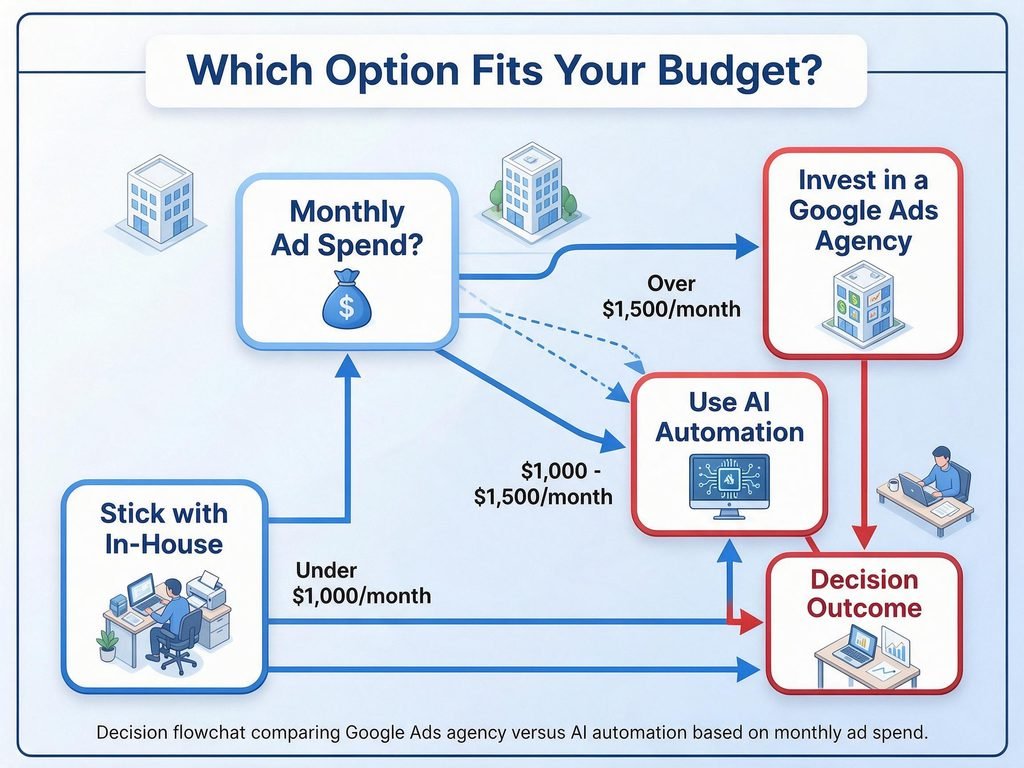
Under $3,000/month ad spend: Opt for AI-powered automation with intermittent freelance management
$3,000-$15,000/month: Think about hiring a small Google Ad Marketing Agency to oversee strategy with AI-powered bidding
Over $15,000/month: A full-service agency with AI tools is your best bet.
Conclusion
There are no universal best practices for the Google Ad Marketing Agency versus AI dilemma, but this article hopefully gave you food for thought. AI will never be matched in terms of speed, scale, precision of bid adjustments. Google Ad Marketing Agency will not be matched in strategic thinking, nuance of creative, and understanding of the idiosyncrasies of the business.
Most savvy advertisers in 2026 already think of combining the two into a single unified system, which would require heavy investment on the compliance side to have full audit trail. Build a system, test, measure, and optimize, instead of relying on hearsay or unsubstantiated proclamations from either side.
Frequently Asked Questions
1. Is it cheaper to use AI instead of hiring a Google Ad Marketing Agency?
In the strictest sense of the word, yes, since most AI tools have a much lower price point than agencies. However, keep in mind that spending less money does not always mean getting a better ROI. A disorganized account with no strategic direction and proper tracking will bleed money just as a poorly optimized campaign managed by an agency would, so consider what you’re spending not only in dollars but in man-hours as well.
2. Can AI completely replace a Google Ad Marketing Agency in 2026?
Not in the near future, at least. AI is good at suggesting optimizations and analyzing trends, but comes up lacking in terms of conceptualization and strategy. Your campaigns may perform well in a first-run vacuum, but once you need to react to outside forces, there isn’t any “marketing AI” built into Google Ads to help you, which is why most companies looking to optimize their campaigns still rely on outside agencies to this day.
3. How do I know if my agency is actually adding value versus just relying on Google’s automation?
Ask them to detail the changes they make to a campaign in terms of Google’s recommended smart bidding options. If the company simply copies Google’s default smart campaign structure, that’s one thing, but most agencies will have their own preferred variations and optimizations so ask about specifics and what they do differently.
4. What role does compliance play in reducing wasted ad spend?
More than you might think. Issues stemming from policy violations, account suspension and billing disputes can cause campaigns to be paused at any time with no warning, wasting any remaining budget that has been queued for spending. The best approach here is to establish some basic housekeeping procedures for your billing and policy issues as a way of preemptive maintenance.
5. How much wasted ad spend is “normal” for a small business account?
It’s hard to say, but 20-30% is generally considered to be an acceptable loss in an improperly maintained account, and most agencies or AI optimization tools should be able to bring that down to single digits in a matter of weeks or months. A large portion of budget waste in small business accounts tends to come from disorganization and improper tracking rather than any fundamental flaw in strategy.