
Payroll Service Providers for Small Business vs. DIY Payroll: Which Saves More Money?
If you’ve ever sat down at the kitchen table at 11 p.m. working on FICA withholdings while your coffee goes cold, then you already know the real question that haunts every small business owner isn’t “can I do payroll myself?”, but rather “should I?” Whether using a payroll service for small business companies or handling it in-house, this dilemma will always involve a trade-off of sorts. After all, your time is valuable, spreadsheets come at no cost, and errors do have a price.
In this article, I’ll compare and contrast the numbers as well as identify some of the ways in which businesses that choose to handle payroll internally can quietly bleed cash and why more small business owners are combining payroll outsourcing with compliance management software solutions.
Table of Contents

What Does DIY Payroll Cost You?
While many small business owners are drawn to the idea of doing payroll themselves in order to avoid paying a professional payroll service, this option usually comes with hidden costs. In this section we will examine the various expenses associated with DIY payroll and why they may outweigh the benefits.
Hidden Time Cost
To begin, independent contractors and small business owners who perform their own payroll generally spend anywhere from 4-to-8 hours on calculating, recording and paying employee wages, according to the National Federation of Independent Business (NFIB) .
This means that if you are spending 4 hours every two weeks on payroll calculations alone, you could be spending over 100 hours per year on this chore. If your hourly rate on projects is even $40 an hour (and for most owners, it’s worth far more), that’s $4,000+ in lost revenue every year, this figure doesn’t even show up on an invoice for your payroll service.
Risk of Payroll Penalties
Another expense to consider with do-it-yourself payroll services is the risk of payroll penalties. According to the IRS , approximately 33% of small businesses face penalties related to payroll taxes each year. These penalties, which can total anywhere from 2% to 15% of the unpaid tax balance, are caused by deposits of federal taxes being made late, or amounts of withheld taxes being reported incorrectly to the IRS.
Software Subscription
Finally, small business owners who choose the DIY payroll option must purchase some sort of payroll software to help them track and report taxes. This can cost between 40-80 USD per month for a self-file payroll service like QuickBooks Payroll or Wave.
How Payroll Service Providers for Small Business Work
So what exactly are you paying for when you outsource? Well, it’s called outsourcing for a reason. The payroll companies that offer full-service payroll solutions specialize in handling the tax portion of payroll.
Full-Service vs. Self-Service Payroll Providers
There are two types of payroll providers:
Self-service providers: You enter the information, and the software does the math and generates paychecks. These are generally much cheaper than full-service providers, but you’re responsible for any errors.
Full-service payroll providers: These companies do the math, pay your taxes, and file them with the IRS and your state and local governments. Year-end tax forms like W-2s and 1099s also get handled, and most full-service providers will even pay penalties if errors occur. The value-add is obvious: Providers like Gusto , ADP , Paychex , and OnPay dominate the small business market by taking on this risk.
What’s Included in the Price
Small business payroll service providers that offer full-service options usually have a base price ($40) plus $6-$12 per employee per month. For a 10-person team, that’s roughly $100-$160/month, or $1,200-$1,900/year). These plans generally include:
- Automated tax filing (federal, state, and local)
- Direct deposit capabilities
- New hire reporting
- End-of-year tax form preparation (W-2s, 1099s)
- Error protection (some companies buy this as an add-on)
Real Cost Comparison: DIY Payroll vs. Payroll Service Provider
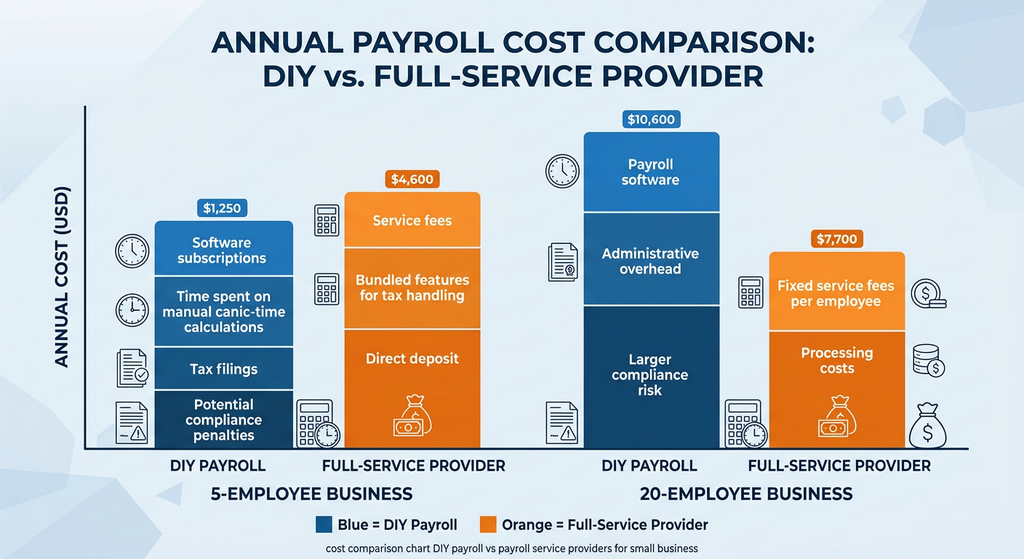
Numbers tell the story better than opinions do. Let’s put two common small-business scenarios side by side.
Small Business Example (5 Employees)
| Cost Factor | DIY Payroll | Full-Service Provider |
|---|---|---|
| Software/Service Fee | $50/month | $40 + ($8 × 5) = $80/month |
| Owner’s Time (5 hrs/pay period × 24) | ~$4,800/year (at $40/hr) | ~$500/year (review only) |
| Penalty Risk (avg. annual) | $500–$1,500 | Near $0 (provider guarantee) |
| Estimated Annual Total | $5,900–$6,900 | $1,460 |
Growing Business Example (20+ Employees)
As the number of employees increases, the complexity of the DIY payroll approach grows exponentially. This is due to factors such as multiple state tax withholdings, benefits deductions, and overtime wages, which may add up to more than $10,000/year, while a full-service provider might run $2,500–$3,500/year in costs. Furthermore, the time investment in terms of hours spent on calculations grows substantially with every additional worker.
It could be concluded that the break-even point is when a company has fewer employees and less complex tax needs while also being confident in their own ability to calculate taxes and payrolls correctly.
In Addition to Payroll: Compliance Management Software
The payroll wizardry is only part of the puzzle, however, as companies must also adhere to a variety of relevant regulations and document all pertinent information. It is therefore not surprising that many small business owners who utilize payroll services also invest in compliance management software that helps them stay within the bounds of the law.
Compliance Software for Small Business
Compliance software for small-business owners tends to focus on regulations pertaining to labor laws and safety standards, among other areas. By using such software, companies effectively track and document all necessary information related to workers’ safety and compliance with external standards, such as OSHA. Doing so reduces greatly the risk of non-compliance with tax and labor laws and the financial and reputational damage that would follow.
Automated Compliance Management and GRC Software
Small businesses with larger employee counts and aspirations for growth, however, may want to consider an alternative form of compliance management that utilizes automation. This type of software is designed to resemble its enterprise-level counterparts, such as Governance, Risk, and Compliance management systems, but adapted to the needs of small businesses. In effect, automated compliance management tools help companies in the early stages of growth reduce the time spent auditing and calculating manually by automating many of these processes. Moreover, such tools provide companies with the ability to generate audit trails and documents as needed.
For companies considering an investment in back-office software, it is recommended to consult resources such as the Moneticks guide to compliance management software, which analyzes the needs of small businesses and the ways in which they can satisfy those needs using compliance management tools. For businesses that wish to learn about tools that provide automated compliance management functions, the previous paragraph about GRC software for small businesses is relevant. Meanwhile, companies that seek to grow are encouraged to consult the piece on automated compliance management systems, as it will help them prepare for the transition from spreadsheets to software.
How to Choose the Right Payroll Partner
Some payroll vendors are created equal, but choosing the wrong partner could be as expensive as not outsourcing at all.
Key Features
- Tax filing guarantee – do they cover penalties in case of an error?
- Transparent pricing – are there any hidden fees besides the base cost per paycheck?
- Does the payroll service provider integrate with your accounting software (QuickBooks, Xero, etc.)?
- Multi-state payroll coverage – do they support direct deposit and tax filing in all the states your remote employees work in?
- Can their solution scale with your business – will you have to start from square one when you reach 10, 20 or 50 employees?
Warning Signs
- Unclear pricing structure that requires “custom quote” for a mid-size business ($50K+ payroll)
- Customer support available only via chat with no dedicated phone line for urgent tax-related issues
- Numerous negative reviews mentioning tax filing errors – research Better Business Bureau and G2/Capterra reviews before signing up
Conclusion
Thus, the choice between DIY payroll and payroll service providers for small business depends on the particular circumstances. If the single founder of the company has only two employees and a straightforward taxation scheme, it makes sense to try it out. At the same time, as soon as the hiring of new workers, accrual of benefits, and different states’ taxes are involved, the benefits of the “do it yourself” approach are no longer relevant due to the risks and time-cost of maintaining the payroll independently.
Although full-service providers require paying more, their services typically end up being more cost-efficient in the long run due to fewer mistakes, fewer penalties, and less time spent on documentation and bookkeeping. Finally, if a company wants to scale and operate as a real business, investing in compliance management software or automated compliance management software as a part of the broader suite of compliance tools is no longer an unnecessary luxury – it is a strategic decision to remain competitive.
Frequently Asked Questions
1. Under what circumstances is it advisable for small businesses to take on the task of their own payroll?
The task is only recommended for solo entrepreneurs, landlords, small companies having 1-2 employees, who do not provide benefits and operate in a single state. The moment the enterprise starts to employ persons in several states, hire contractors and subcontractors and offer benefits to employees, the costs of mistakes during payroll preparation offset any potential savings.
2. How much does a payroll service for small business usually cost?
A company ready to provide payroll services for small businesses usually charges a monthly round fee from 30 to 50 USD and an additional 6 to 15 USD for each employee listed monthly. Thus, the total cost depends on the number of employees and varies from 1200 to 3000 USD per year.
3. What happens if a payroll service provider makes an error in tax filings?
Reliable payroll service providers which offer full-cycle payroll services including tax filings and deposits do not allow errors. If such an agency makes a mistake, it corrects it at its own expense since errors lead to additional penalties.
4. If I choose a payroll service, will I still need to invest in compliance software?
Small businesses usually need to invest in separate compliance software even when using payroll service providers. The reason is that payroll service providers are only responsible for payroll taxes, whereas enterprise compliance software takes care of labor laws, tax laws, and safety regulations. Thus, a company needs both solutions to remain fully compliant and audit-ready.
5. How can I change from doing my own payroll to using a payroll service provider?
Most providers are ready to import historical payroll data and existing tax deposits to create a reliable picture for year-end tax filings. It is better to change payroll service providers at the beginning of the new quarter or tax year to avoid the need for two year-end filings.