Get SOC 2 Certification in 2026: Step-by-Step Process, Cost & Timeline
If you’re searching Get SOC 2 Certification in 2026, you’re probably not inquiring out of curiosity – there’s a concrete business reason to want to know about costs, timelines, and decision factors that differentiate options (Type I vs II, extent, tools, resources) that impact budgets.
Additionally, a brief note on terminology: despite the name, SOC 2 is an attestation, rather than a certification (and one that doesn’t carry an ongoing status from a regulating body). With that said, buyers consistently request “certification” when they mean attestation, and your procurement teams will likely ask for this in their vendor questionnaires – and so this guide will use the buyer-facing terms, while being clear about nuances in execution.
This guide is created as a buyer’s walkthrough: rather than an education piece, it’s a discussion of the logical progression of steps, the cost stack, timeline estimation, and decision points (and how to avoid paying for unnecessary ones).
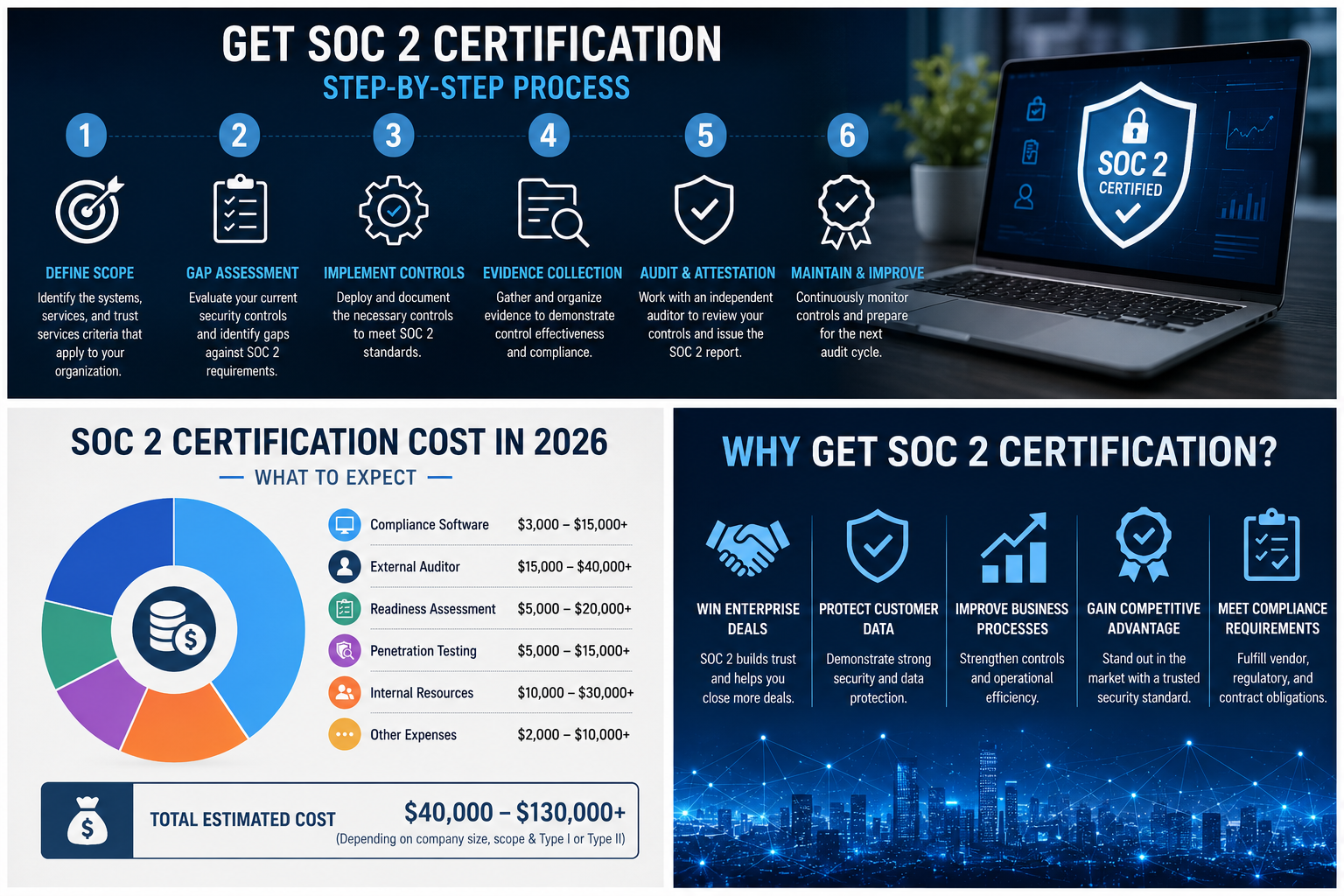
Step-by-Step Process in 2026 (Buyer-Ready Checklist)
Think of SOC 2 as a project with five moving parts:
- Scope & criteria
- Control design
- Control implementation
- Evidence collection & operations
- Auditor engagement & reporting
1. Decide on a SOC 2 “type”
Type I is design and implementation effectiveness at a point in time, while a SOC 2 Type II focuses on design/implementation as well as operating effectiveness over a period (often 3-12 months)
Procurement tip: many enterprise customers request Type II to evidence controls operate consistently. If you do a Type I, you may still be asked to get a separate Type II with potential double spend.
Recommendation: if your sales pipeline is enterprise-heavy in 2026, start by identifying which report your largest customers would want first and aligning your SOC 2 spend and effort.
2. Decide on the Trust Services Criteria (Security is the usual starting point)
Common focus areas:
Security (almost always requested)
Sometimes Availability or Confidentiality
Privacy is specialized and more complex
Fast-track reality: Adding criteria increases work scope and evidence volume. If you want speed, start with the criteria your buyers are asking for.
3. Decide on a scope (systems, applications, and data flows)
This is where projects either accelerate or spiral.
You’ll want to document:
In-scope systems (production, internal tools, key infrastructure)
Data types and flows
Service boundaries (what you control vs. what vendors control)
Speed pit: Over-scoping “just in case.” This can make auditor testing more broad and potentially extend timelines.
4. Build controls and map to evidence early (before tools)
Your controls need an evidence strategy: what will provide assurance that this control operates effectively?
A practical way to do this is to create a control inventory, and for each control, define:
- owner
- frequency (once, weekly, monthly)
- evidence type (logs, tickets, screenshots, reports)
- retention or location of record …where compliance management or GRC software can help (if set up around this control-evidence index)
5. Core controls to implement first (controls that unlock everything else)
In many startups, these controls represent 70-80% of momentum:
Identity & Access Management
MFA for all admin-level access
Joiner/mover/leaver process
Access reviews (at defined intervals)
Logging and monitoring for privileged actions
Change Management
Controlled deployments
Approvals/workflows
Evidence of releases and rollback procedures
Security Operations
Logging coverage and retention
Vulnerability management (scans + remediation evidence)
Incident response plan + tabletop evidence
Vendor Management
Contractual security terms
Vendor risk assessment cadence
Evidence that vendor controls are assessed and monitored
6. Engage an auditor (and avoid “late-stage surprise”)
Auditor selection is important in 2026 because:
Some auditors move faster with startups
Some auditors have a higher tolerance for documentation style
Some auditors require specific evidence formats or sampling approaches
Your best move is to do a readiness assessment first (often with a compliance consultant or platform-backed review) so you don’t learn about gaps during testing.
7. Evidence collection/control operation (this is where the time goes)
While SOC 2 requires policies, you need to show operational effectiveness:
Tickets/approvals
Log exports
Scan results
Review attestations
Training completion
Vulnerability remediation tracking
For a Type II, you need to operate these controls effectively over the reporting period, so this is key to planning the control operation cadence.
8. Final audit/report delivery & “what buyers expect next”
After testing, your auditor will deliver the SOC 2 report, which you’ll then package for customer/security reviews. You’ll also need to continue operating controls to reduce the risk of findings.
Cost Stack for Get SOC 2 Certification in 2026 (What Buyers Actually Pay)
There are no single SOC 2 costs — there is a cost stack. Here’s what typically comprises the spend:
1. Auditor fees
This depends on:
Type I vs Type II
The scope (how many systems, environments, products are audited)
The complexities of your control environment
The number controls and evidence testing required by the auditor
A common planning pitfall is underestimating auditor fees by focusing on the price of “the report” and neglecting the project scope needed to enable auditor testing.
2. Readiness consulting / implementation support
Depending on your needs, this could encompass:
Compliance consultants (manual process, bespoke support)
Platform-assisted implementation (GRC and compliance tools, plus guided setup)
Hybrid: your team + a consultant for critical areas
It depends significantly on how much is already “productionized” versus needing to be built from scratch.
3. SOC 2 compliance software & automated compliance management
There’s a spectrum of solutions:
Compliance management software
Automated compliance management
GRC software for control mapping and evidence gathering/reporting
Policy management + training tools
Ticketing integrations for gathering evidence
What you’re usually buying is time and consistency of evidence, not just dashboards.
Procurement nuance: If you intend to do this repeatedly (and you should, in 2026), software helps you reduce the friction of repeat audits.
4. Penetration testing and vulnerability management
The price reflects:
The product’s and architecture’s complexity (web app, APIs, mobile, infra, etc.)
Whether the engagement targets a single category or all
The expected scope and depth of testing, as defined by buyers and/or the auditor
Even if your controls around vulnerabilities are adequate, SOC 2 often includes penetration testing as part of the security controls evidence.
5. Internal effort (the “hidden” cost”)
This eats up the largest chunk of effort in most organizations. It usually takes the form of:
Owners for controls that require processes to be followed
Owners for evidence that require exports or records to be pulled
Engineering effort for logging, access, and remediation
Leadership time to triage and define control ownership
Planned or not, internal effort always ends up being scheduled in elongated timelines if it’s not budgeted explicitly.
Timeline: How Long It Takes in 2026 (Realistic Ranges)
Here’s a practical planning model:
Type I timeline (typical)
2-6 weeks for scoping, control mapping, and initial gap remediation (if you are already mature)
4-12 weeks to implement controls and collect evidence.
Auditor scheduling and readiness review can add time.
Total planning range: ~1-3 months, for teams performing relatively well in terms of security operations.
Type II timeline (typical)
Type II requires ongoing operations of controls, so the timelines are often like:
Setup + implementation: 1-3+ months
Operation period for reporting (typically 3-12 months, depending on customer requirements)
Evidence stabilization and final audit: 1-2+ months
Total planning range: ~4-14 months, depending on the duration of your Type II and how soon you can become audit-ready.
Fast-track truth: In many cases, fast-track is about shifting to “operational” evidence rather than policy writing.
Decision Guide: What to Buy vs What to Build (and How to Compare Options)
To ensure that your project scope is well-defined, choose your in-scope controls early on
Compliance software comparison guidelines (what to look for)
When comparing compliance management software or GRC software, you should consider:
Control mapping to auditor expectations
Evidence collection workflow (exports, attestations, log imports)
- Connectivity to identity providers,
- ticketing systems,
- CI/CD platforms,
- and vulnerability scanners
Automated compliance management features such as
reminders to control owners
scheduled reviews
audit trails of evidence changes
A probing question to test a vendor’s ability to reduce evidence scrambling during audit week is “Can we reduce evidence scrambling during audit week?” If they can’t give you a detailed plan, you may end up doing a lot of manual work despite the software.
The auditor, readiness consultant, and platform (a common recipe for 2026)
In 2026, we see readiness assessments used to de-risk engagements followed by compliance software implementation + playbooks and then auditor testing to scope “gaps” of the initial findings.
Conclusion
Achieving SOC 2 in 2026 is less about finding the right “checklist” and more about scoping the engagement as a buyer would (define Type, limit scope, implement the specific controls that generate evidence), and using compliance management software or GRC software to standardize control owner procedures. Having an accurate budget (including auditor, readiness, automated compliance management software, penetration testing, and internal resources) will help you accelerate the process and reduce surprises.
Frequently Asked Questions
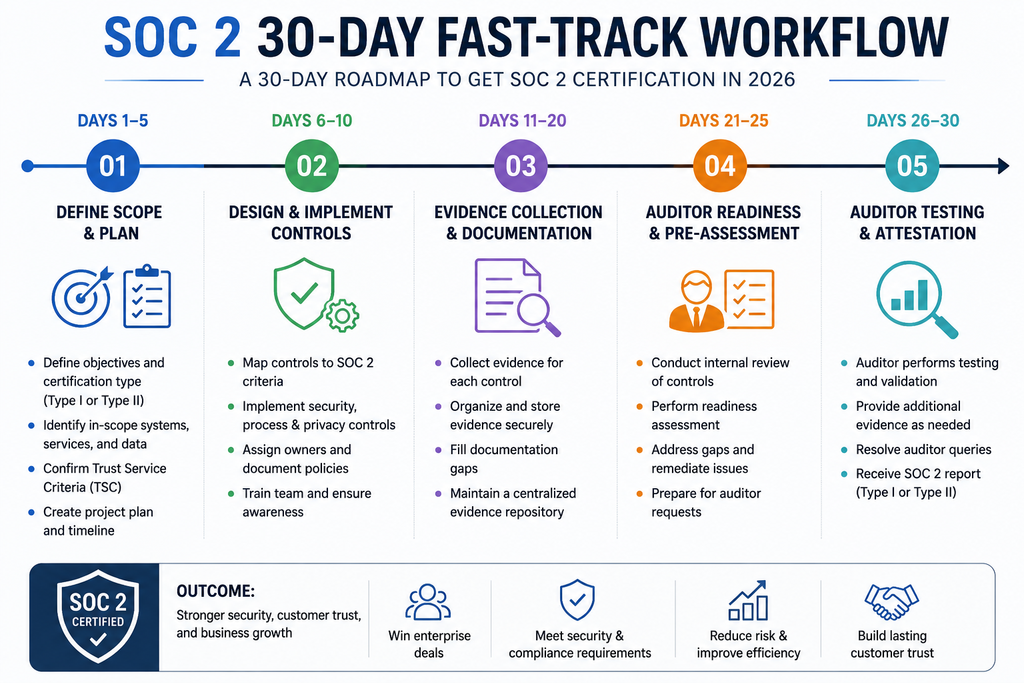
Can we Get SOC 2 Certification in 30 days to 4 weeks in 2026?
Depending on your maturity, scope, type (type I or type II) and available auditor slots, you may be able to get ready for a type I SOC 2 audit in 30 days. However, for type II you need to have systems and processes in place for a period of time which means 30 days is too short for this particular report.
What are the main factors that increase SOC 2 cost in 2026?
The main factors that contribute to the final price are:
Scope of the audit (how many systems and environments require assessments)
type I or type II
control complexity
audit evidence
additional security assessments (penetration tests)
internal compliance management and internal control maturity
It’s important to understand that costs are often higher than expected mainly due to internal factors.
Should start-ups go with automated compliance management or manual processes?
If you have a small team, it might make sense to rely on automated solutions for ongoing compliance management to avoid mistakes associated with manual evidence collection. If you go this route – make sure to pick a platform that can help automate repetitive tasks associated with compliance evidence collection, remind you about audits and other activities. Otherwise, manual processes will require significant resources during the quarterly/annual evidentiary window.
Do we need penetration tests for SOC 2?
Some of the frameworks require proof of vulnerability management – which may involve penetration tests. Whether you need them or not depends on your control objectives, risks, scope, and what your customers expect from you. In many cases, penetration tests are a part of a larger security program that helps organizations achieve better results during independent audits, assessments, and customer evaluations.
What’s the best way to prevent SOC 2 audit delays?
The best way is to avoid late scoping and late evidence collection. Here’s what I recommend:
early scoping and control mapping
discussing control objectives and evidence requirements
running a pre-audit readiness assessment
implementing logging, access controls, change management processes and vendor management
This will prevent the “we have made the changes, but we cannot provide the evidence” scenario.