Virtual Data Rooms Pricing: What Should You Pay for M&A, Due Diligence & Fundraising?
Let’s face it – nobody likes to read the pricing page. However, when it comes to a deal, a deal diligence project, or raising the next round of financing, virtual data rooms pricing is one of the last things that you want to miss. Picking the wrong pricing plan or a wrong vendor may cost you $10,000 for a deal that should’ve cost $2,000, or make you select a cheap but insecure solution that lets all your confidential documents leak.
I’ve been through these situations, and I will help you avoid the most common mistakes regarding VDR costs. Let’s look at what you may be expected to pay, what influences the price, and analyze the most common pitfalls.
Table of Contents
How Virtual Data Rooms Pricing Actually Works
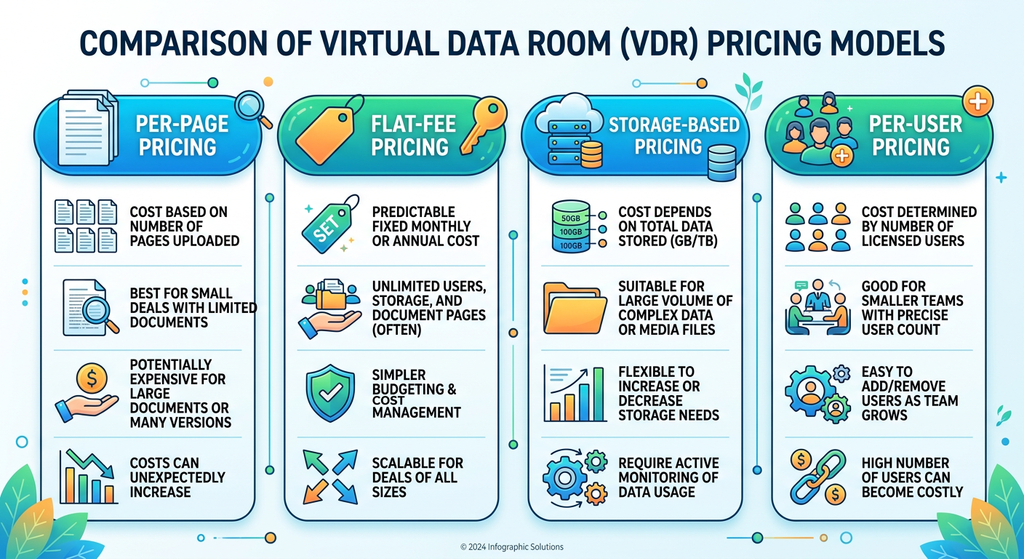
Here’s the thing that nobody will tell you when comparing VDRs: there is not one particular pricing scheme for virtual data rooms. There are at least 4, and vendors tend to combine several to confuse you.
Per-Page Pricing (The Old-School Model)
This option represents the most expensive based on the history of VDR pricing. This subscription model was popular in the era when data rooms were paper-based physical storage units. The billing principle was simple — the client paid for each page uploaded to the VDR at a rate of approximately $0.40 to $0.85. By itself it seems like a great offer for a small-scale transaction, but a moderate M&A due diligence involves a minimum of 50,000 pages of various documents including financial reports, contracts, employee records, and intellectual property registrations. In this case, the cost of storage alone will exceed $20,000-$40,000.
Flat-Fee / Subscription Pricing (The Modern Standard)
Most reputable providers — think Datasite, Intralinks, Firmex, and Ansarada — have shifted to flat monthly or per-project fees. This is far more predictable and, frankly, the model I’d recommend for 90% of buyers. You typically pay:
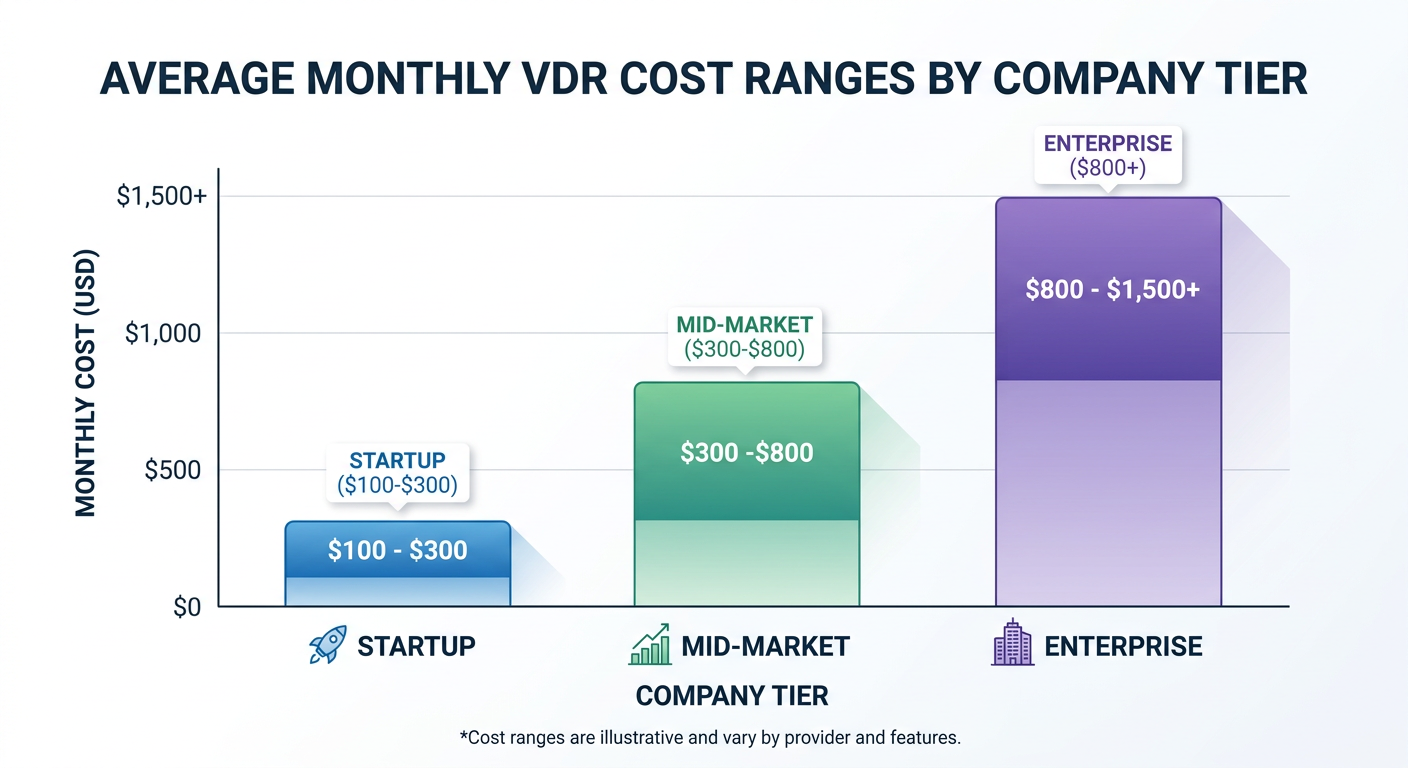
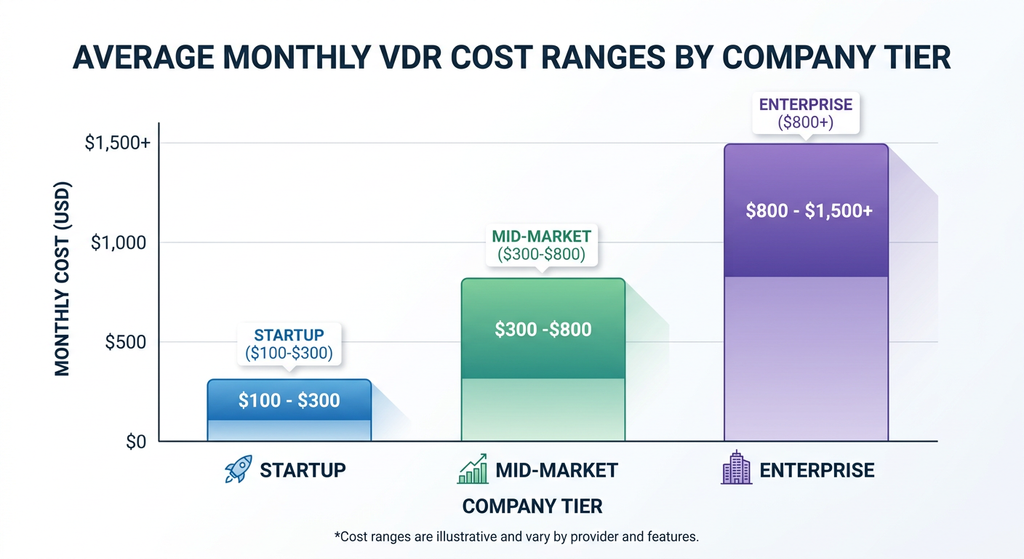
- Starter plans: $99–$400/month for small projects (fundraising, single due diligence engagements)
- Mid-tier plans: $400–$1,500/month for active M&A deals
- Enterprise plans: $1,500–$5,000+/month for multi-deal, multi-entity organizations
Storage-Based and Per-User Pricing
Some vendors charge by gigabyte of storage (often $250–$500 per GB beyond a free allotment) or by seat/user ($20–$100 per user, per month). If your deal team includes lawyers, bankers, auditors, and potential buyers all needing access, this adds up fast — sometimes faster than the base subscription itself.
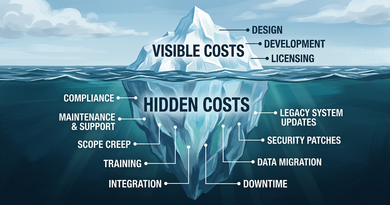
Hidden Fees You Should Watch For
Here are some examples of where companies have gone over budget on database deals. Beware of:
- Setup and onboarding fees ($500 – $2000 one-time)
- Additional redaction tool features
- Q&A modules (common for auction-style M&A deals)
- Extended data retention period
- Overage costs for users/storages over the limit
- Always ask for an itemized quote – the “starting from” price on the website rarely covers everything.
Average Virtual Data Room Costs by Use Case
The software’s cost depends not only on the vendor but also on the specific use case. Let’s take a closer look at the different scenarios and see how they impact data room pricing.
M&A Transactions
A virtual data room for M&A transactions (sell-side or buy-side due diligence) is usually the most expensive type of deals because of their complexity and the number of involved parties. Most providers charge between $500 and $2500 per month for 6-12 month long projects with a high document volume. For deals that require year-long cooperation and have multiple stakeholders on both sides, the price can go up to $3000-$10000 per month, depending on the level of support and dedicated project management.
Due Diligence Projects
Due diligence projects that are not related to M&A transactions tend to be cheaper and shorter. The typical budget for such a deal ranges from $150 to $800 per month.
Fundraising and Investor Data Rooms
Investor data rooms for series A financing or other fundraising activities are usually the cheapest type of deals. Most providers have a special budget for startups and small businesses that can range from $99 to $300 per month, depending on the set of available features.
Small Businesses vs. Startups vs. Enterprises
While choosing a VDR solution, enterprises should focus on advanced security features and collaboration tools. For small businesses and startups, features such as e-signature and reduced pricing per user per month are more important. The rule of thumb for determining the needed scope of service is to avoid paying for the functionalities that the business does not need. At the same time, enterprises should not go for a cheaper solution with fewer collaboration features as it might hinder the teamwork process. In terms of security, it is better to choose a VDR with an extended set of security features and certifications (SOC 2, ISO 27001, and others) than to risk losing important documents.
What Makes the Price Go Up (or Down)
Security and Compliance Features
Features like encryption, two-factor authentication, granular permissions, watermarking, and audit trails increase costs but are also essential for sensitive deals. This is where VDRs are starting to overlap with compliance management software, as mid-market and enterprise providers roll out deeper governance tools. VDR providers are starting to offer the kind of policy tracking features you typically find in dedicated Governance, Risk, and Compliance (GRC) software.
Number of Users/Admins
The more users you need to grant access, the higher the price, and the more care you need to take with permissions. You should look for vendors that offer role-based access controls so you aren’t paying for expensive administrative seats for everyone who needs read-only access.
Integrations with Compliance Management Software and GRC Tools
If you use or are considering automated compliance management tools, or have broader compliance software for small businesses already in your tech stack, ask whether the VDR you’re evaluating will integrate with it natively. Integrations save time and money by removing the need for separate licenses for both systems, and while they often don’t show up in pricing comparisons, they can be a major differentiator.
Support, Training, and Onboarding
While white-glove onboarding and dedicated deal managers are typically reserved for enterprise-level contracts, they can be worth the investment for any time-sensitive deal at the entry level.
How to Choose the Right VDR Without Overpaying
Questions to ask before signing
- Is the pricing on a per-page basis, flat-rate, or depends on the platform’s usage?
- Are there any limitations to users, storage, or documents?
- How does the acquisition period’s extension beyond the contract affect the price?
- Does it offer compliance certifications?
- Is it possible to integrate VDR into GRC software or compliance management tools?
Red flags
- A custom pricing policy without any specific ranges stated (in many cases, such VDRs’ cost more than companies using enterprise-wide solutions)
- Auto-renewal subscriptions with a short notice period to cancellation
- Extra fees for data export after the deal is closed (this is a tricky detail since many providers let you off by not mentioning them at all)
When automated compliance management saves money
Deals that require compliance with different regulatory domains (common in cross-border M&A) can benefit from a tool that automates compliance management to reduce costs. For example, the manual work involved with reviewing and distributing documentation to dozens of stakeholders can add up to hundreds or thousands of billable hours.
Conclusion
Virtual data room pricing is far from standardized – it may well start at less than $100/month for a lean startup fundraising round to $10 000+/month for a complex M&A transaction involving multiple parties, but it’s always smart to structure your choice around your particular use-case: no point in paying extra for a per-page-rate if you know your deal is going to be long-term, or incurring enterprise-grade security costs just to raise funds. Pay particular attention to terms and conditions of use and any exit clauses.
If your organization has compliance management as a priority, think about selecting a vendor that offers greater compatibility with other compliance management or generalized regulatory control (GRC) software: the productivity gains may more than compensate for any additional costs involved. Armed with this general knowledge of virtual data room pricing, you’re now in a far better position to negotiate the most suitable option for your needs. Be sure to request itemized pricing from at least three vendors as a minimum.
Frequently Asked Questions
1. What is the average cost of a virtual data rooms for a small business fundraising round?
The average cost for small businesses and startups to use a VDR for fundraising purposes is usually $99 and $400 monthly for a fundraising-specific virtual data room. The reduced price is justified since smaller deals have fewer documents and participants than a standard M&A transaction. The most popular providers of fundraising data rooms are Digify and DealRoom which both offer special packages for young companies.
2. Is per-page pricing ever a good deal for virtual data rooms?
It doesn’t offer much value for deals that have a serious scope (i.e., thousands of pages of documentation). Any seasoned professional will tell you that it’s better to pay a subscription for a VDR instead of getting charged per page viewed. A flat-rate plan will prove to be more cost-effective and transparent.
3. Do virtual data rooms integrate with compliance management software?
Yes, many VDR providers offer compliance management modules and API ports to connect your program with external GRCS software. You may want to centralize some of your regulatory documentation in a VDR to keep it secure but still accessible to your compliance officers and third-party regulators.
4. How long do virtual data rooms contract typically last?
Most VDR service contracts state a 3-12 month commitment, depending on the scope of the deal. It’s always a good idea to negotiate the option to extend the contract without additional costs since deal negotiations often drag longer than initially projected.
5. What’s the biggest mistake companies make when budgeting for a data room?
The most common error is not researching the costs associated with the number of users and documentation storage. In most cases, organizations tend to underestimate the number of participants interested in reviewing the documents. You should budget an extra 20% to cover unexpected expenses.