7 Signs You Need Employee Management Software for Small Business (Not Just Spreadsheets)
If you’re currently managing your PTO requests in a Google Sheet and responding to timesheets via text messages, I’m fully aware of why you continue to do so. Spreadsheets are convenient, easy-to-use, and, most importantly, familiar. However, the harsh reality of the modern professional world is that employee management software for small business has become a necessity. The Software Report states that small businesses comprise over 99% of all businesses in the U.S. And the good news is that the majority of these organizations have already adopted paper-based management systems. The question is, how will you know when it’s time to move on from spreadsheets? Let’s discuss the signs that it’s time to invest in small business employee management software.
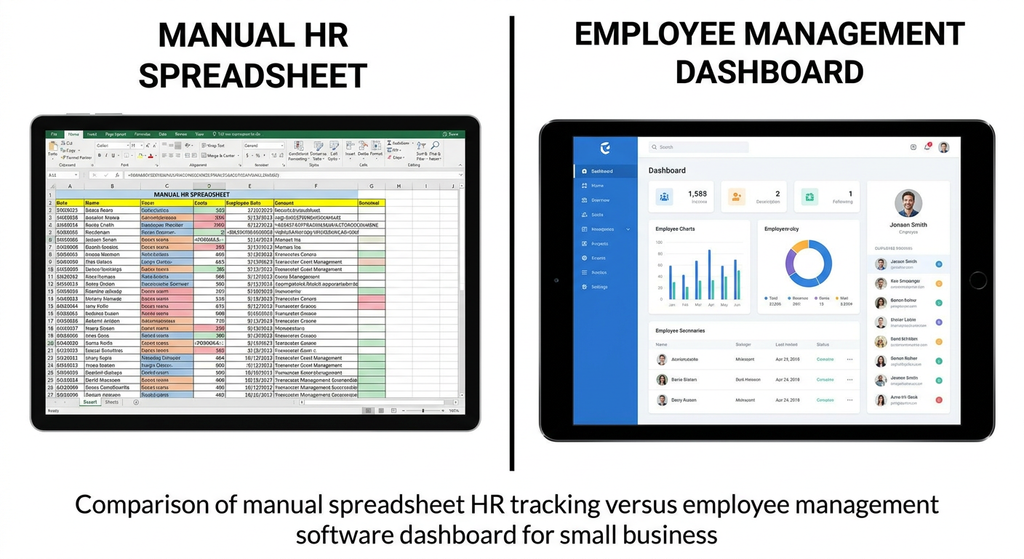
Table of Contents
What Exactly Is Employee Management Software (And Why Spreadsheets Fall Short)
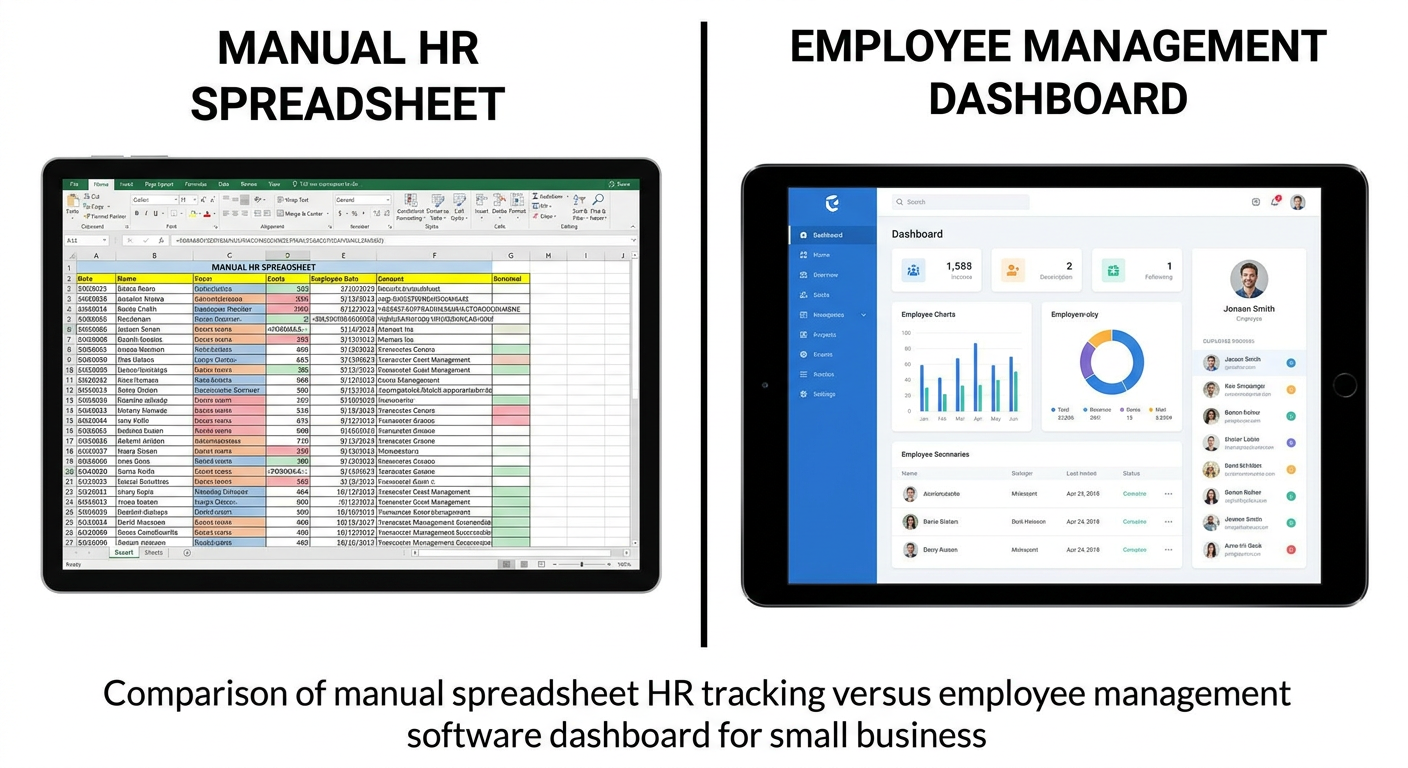
A spreadsheet is a tool not designed for people but for numbers. While Excel experts can perform amazing miracles, it was never intended to be a central nervous system for attendance tracking software, compliance monitoring systems, or performance reviews (that inevitably get buried in a Copy of Copy of Final_v3.xlsx).
Employee management software for Small Business is a centralized database that stores and tracks employees’ information throughout their work with the company. It usually includes full-cycle solutions covering the hiring process, scheduling, payroll, performance management, and other functions. In other words, it is an operating system for employees, similar to how QuickBooks is an operating system for finances.
The Real Cost of Spreadsheet Chaos
Here’s what nobody will ever tell you about spreadsheets: they waste time and money, and not just a little. It’s easy to miss an overtime payment, forget about a certification expiration, or book an employee at the same time for two clients, resulting in one angry customer and a frustrated employee.
Human error is inevitable when you add new employees and their information to a shared spreadsheet
There’s no audit trail that could show the Department of Labor that you’re an ethical company that takes care of its workers.
Plus, nobody wants to spend hours and hours entering the same information in different applications. If any of this sounds familiar, read on to find out how we’ll know if you’re a good candidate for our software.
We’ll recognize you’re a good fit right away if:
- You feel like you waste too much time on payroll and not enough on actually running your business
- Nobody on your team has any experience with complicated payroll software
- You have to enter employee data into multiple programs
- Any of these might indicate that you need our help.
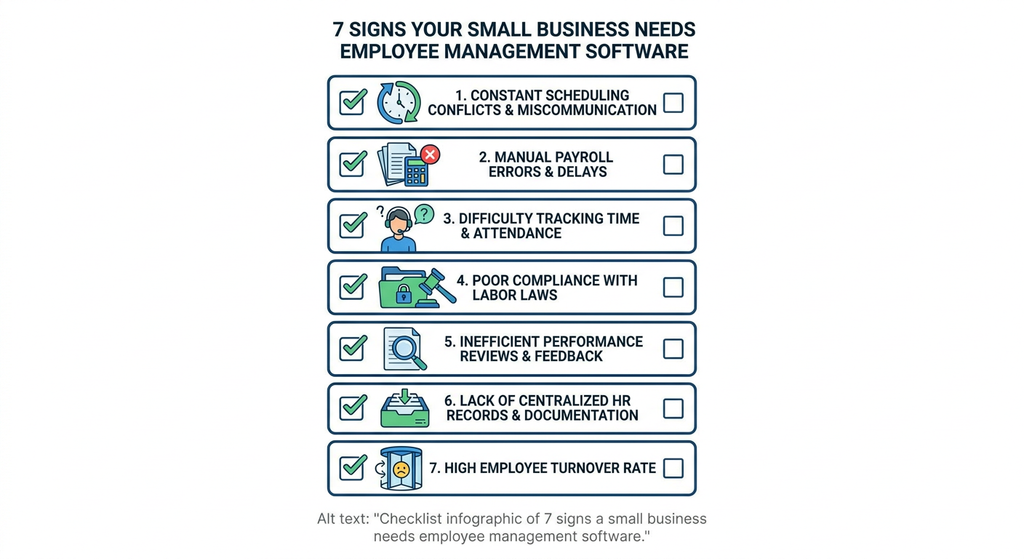
7 Signs You Need Employee Management Software for Small Business
You’re Spending More Time Data Entry Than Actual Managing
Your days are consumed with spreadsheet management, leaving little time for other issues for human resources managers and employees in charge of human resources department. Employee management softwares can take over mundane, time-consuming tasks to free up your time for more important things.
Payroll Mistakes Are Common and Costly
When mistakes occur, it causes serious issues with employees and payscales. One wrong cell entry can make an employee lose two hundred bucks. Payroll errors are common and can stick around when using other methods and spreadsheets. Payroll management software can integrate with employee management software and eliminate errors.
Compliance Is a Difficult and Lengthy Process
Compliance requires a lot from employees and business owners. It also requires a strict monitoring process. Human resources software for small business can take some of the hassle of tracking changes, certifications, and logs associated with compliance monitoring on the company’s behalf.
New Employees Have Too Much Paperwork Attached to Them
Onboarding is troublesome for companies and new employees. It requires filling up forms as well as going through other documentation, which is tedious for you as a manager, a new employee and their family. Having such a process in place allows businesses to maintain consistency while eliminating lost papers and missing signatures.
You Are Failing to See Work Patterns
Although spreadsheets are great at compiling information, they don’t process and compile this information into useful insights about patterns. A good software, on the other hand, helps identify these patterns and determine if employees are dependable, consistent, and punctual.
Scheduling Issues Stress You
Scheduling mishaps require exhausting conversations and emails back and forth between staff and managers. Planning tools help managers monitor and respond to requests for shifts or swap shifts and take some of the decision-making process away from you.
Your Company Isn’t Growing Slowly
While spreadsheets have served their purpose, new ventures are requiring a stricter, organized method of organization. There is a critical issue with spreadsheets when it comes to employees, compliance, management and scheduling when a company grows to a certain scale. Spreadsheets work fine with five employees, but what happens when this figure grows to twenty-five?
How Employee Management Software Ties Into Compliance
Here is a common misconception among small business owners that gets addressed only when it is too late: The issues of human resource management and legal compliance are deeply intertwined, and a comprehensive approach to the former will always include the latter.
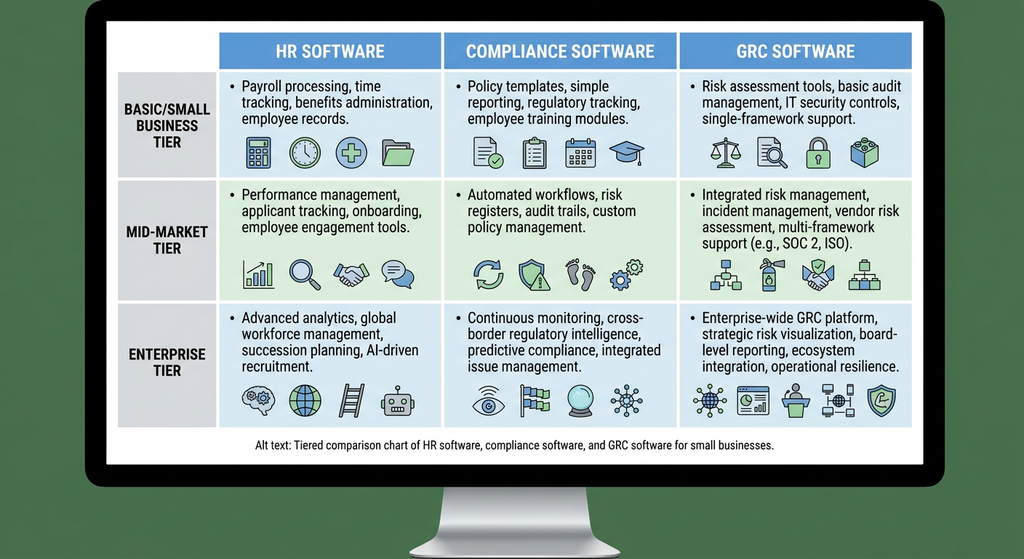
Compliance Management Software vs. Standalone HR Tools
While a simplistic approach to HR management software may address compensation tracking, vacation accrual, and resume curation, compliance management software will take charge of the nuances of labor regulations in the states in which your company operates. Wages, overtime, OSHA, ACA – these are just a few of the constantly changing regulations that apply to your company, and it is not uncommon to be caught unaware and fined for an offense like wrongful termination. According to the Society for Human Resource Management (SHRM), employment law violations are among the most common and expensive for organizations to deal with.
Why Automated Compliance Management Matters for Growing Teams
An automated approach to compliance management is critical for organizations that plan on growing and entering the international space. Where one person reviewing compliance documents and regulations for five employees in one state may be manageable, the same process becomes error-prone and time-consuming when dealing with a larger spread of remote workers. Software that handles labor regulations for you will automatically adjust to changes in the law in any state you operate in and notify your team of any upcoming renewals, certifications, and required trainings to keep your workforce ready.
For businesses that operate multiple standards and regulations, from certifications to financial reporting, more comprehensive governance, risk management and compliance (GRC) software solutions are often used. While not common for small business owners, such software solutions exist and present a single dashboard for all regulatory and legal needs of growing organizations.
Choosing the Right Employee Management Software for Your Small Business
Not every tool is optimal for every company – the choice always depends on the industry, team size, and stage of growth of a business.
Below are the must-have features to look for in the applicant tracking system:
An all-in-one database that stores and structures every employee record
Payroll and tax features to streamline and automate the process
Time and attendance logs with built-in tracking and location data
Compliance management with automatic alerts and reminders about certifications and other regulations
Self-service portal where employees can update their info or ask for vacations
The ability to scale the product as the company grows and evolves
If you’re in a regulated industry (healthcare, finance, construction) or you’re preparing for investment, acquisition, or major contracts that require proof of internal controls, it might be time to look beyond basic HR tools toward GRC software. It’s a bigger investment, but it consolidates risk management in a way spreadsheets — or even standard HR platforms — simply can’t replicate.
For a deeper breakdown of how payroll and compliance tools fit together for growing companies, check out this guide on small business payroll and HR tools and this related piece on choosing compliance-friendly financial software on Moneticks.
Conclusion
Spreadsheets worked for you, and that’s not a crime – the majority of businesses start there. However, if you are seeing two or three of the signs above, chances are, it’s time to invest in employee management software for small business and stop losing sleep over payroll and compliance. Such systems are designed to simplify and automate the processes of managing your team, so you can focus on what you do best – working with real people and growing your business. Start by identifying your biggest headache and look for a solution that addresses it right away.
Frequently Asked Questions
1. How much does employee management software typically cost for small-business owners?
The standard pricing for employee management software is between $4 to $15 per employee/month for core features like HR and time-tracking functions, with compliance or payroll options costing significantly more. Most providers have tiered pricing, meaning that a 10-person team will likely spend much less than a 50-person team on the same software.
2. Can I completely replace my accountant or HR consultant with employee management software?
Unfortunately not – unless your accountant has already automated all their processes, which is rare. You can think of software as an assistant, something that can do minor calculations and tracking, but you’ll still need an accountant for anything serious like tax preparation, payroll, and legal advise.
3. If I only have 5-10 employees, is it worth using such software?
In many cases, yes – and you may need it sooner than you think. Even at this level, it can be helpful to automate certain aspects of management and make sure everything is done correctly from the start. It’s also much easier to adopt at this level than when you have dozens or hundreds of employees.
4. What’s the difference between compliance software and GRC software?
As mentioned above, compliance software helps you maintain compliance with regulations and standards. GRC, which stands for Governance, Risk, and Compliance, is a broader concept which covers compliance management, as well as governance and risk management responsibilities. Generally speaking, GRC software is for bigger organizations or those planning to go public, enter new markets, or be acquired by bigger companies.
5. How long does it typically take to set up employee management software?
Most small-business friendly software takes between a week and a month to implement, including migrating existing data into the system and training your employees on using the new tool. The actual process can be much faster, depending on how much information you have to enter, how much automation you can implement, and whether you need compliance features or not, which often requires additional paperwork/state-specific paperwork.


Pingback: Regulatory Compliance Software: Can AI Automatically Track Every Regulatory Change That Affects Your Business in 2026? - MONETICKS