
10 Best Wealth Management Software Solutions for Financial Advisors in 2026
If there is one thing I have learned from working with clients and advisors who spend their Sunday nights reconciling client portfolios across three Excel spreadsheets, it is that this is the year for rethinking wealth management. From the perspective of an RIAs owner, 2026 promises to bring more than just another round of portfolio allocations. I have seen too many advisors waste their time switching between several platforms, dealing with angry customers, and responding to regulatory inquiries to make this another generic marketing-driven article. The truth is that most advisors have little understanding of what these platforms can (or cannot) do for their daily operations.
This is why I put together this list of the 10 best wealth management software options for financial advisors in 2026. I have tried to highlight the critical differences between the most popular platforms in terms of functionality, cost, third-party service integration, security, and the degree to which they can automate a significant part of your operations.
There is a right solution for every RIA, whether you are an individual advisor with $$20 million or a growing firm eyeing $2 billion in assets under management or a part of a larger institutional network. The wrong choice, on the other hand, could waste hundreds of hours of your time during the migration process.
Table of Contents
What to Look for in Wealth Management Software Solutions
Before you start comparing vendors against one another, it’s important to highlight a few characteristics of effective wealth management software. Most solutions in the industry offer a similar set of services, but the best ones are distinguished by their ability to combine the following:
Portfolio accounting and performance reporting
Financial planning tools (goal-based, cash flow, Monte Carlo)
Client portal
CRM and workflow automation
Billing and fee management
Data aggregation capabilities (held away, alternatives, multi-custody)
Most providers can host at least a few of the services above. The only vendors that we consider to be truly “end-to-end” digitized solutions are those that offer all six in one product.
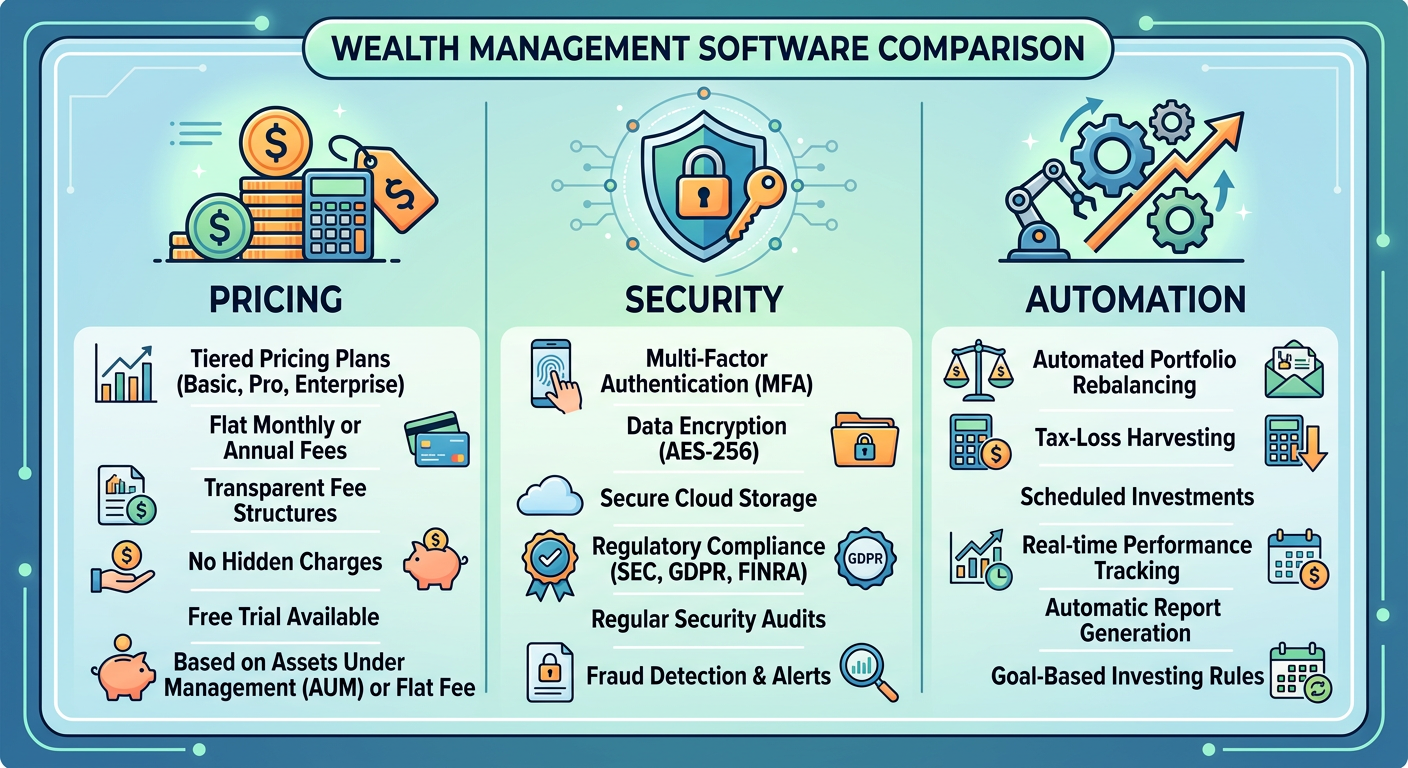
Next, let’s talk about pricing. You’ll often see different fee models across providers: per-advisor, AUM-based, or flat-fee enterprise pricing. We recommend asking for an itemized breakdown whenever you’re talking to a vendor. In many cases, you may find that additional modules (e.g., trading desk, rebalancing, compliance monitoring) will incur extra costs. The initial quote may also fail to consider your firm’s unique requirements (e.g., custodian preferences, reporting standards).
Finally, there are a few non-negotiables that serve as a minimum standard for any vendor in the industry. First and foremost, integration with key third-party platforms (custodians, CRM, compliance tools, etc.) is essential. Second, the platform should possess robust security features and a proven track record of staying ahead of regulators’ expectations. Notably, SOC 2 Type II compliance and data encryption should be a given in 2026, especially with the Marketing Rule and cybersecurity examinations exerting a consistent pressure on the industry.
The 10 Best Wealth Management Software Solutions for 2026

Orion Advisor Solutions
Orion is the closest thing on the market to an all-in-one back-office platform, wrapping portfolio accounting, performance reporting, billing, trading, rebalancing and even Redtail CRM integration into a single solution. It’s a good fit for mid-sized RIAs looking to reduce their vendor footprint, with packages ranging from $13,000-$28,000 annually depending on the firm size and modules selected.
Best for: Growing RIAs looking to consolidate their back-office operations
Addepar
Addepar is all about complex multi-asset portfolio management, and while technically available to everyone, it’s typically selected by family offices and affluent RIAs managing private equity, real estate and alternative assets in addition to traditional securities. The open-architecture data layer makes it exceptionally powerful for aggregating and reporting on difficult-to-manage portfolios, and while deals are done enterprise-by-enterprise, it’s clearly in the sweet spot for RIAs needing to support clients with $6 trillion+ in total managed assets across the firm.
Best for: Family offices and RIAs with complex, multi-asset portfolios
Envestnet Tamarac
Envestnet Tamarac is an enterprise-class portfolio rebalancing/reporting platform with integrated CRM, designed to work in conjunction with Envestnet MoneyGuide to create a seamless goals-based planning and portfolio implementation workflow.
Best for: RIAs of all sizes seeking a fully-integrated planning/portfolio management solution
eMoney Advisor
eMoney has carved out a niche as the leading platform for firms focused on helping clients with financial planning. Its cash-flow based approach and interactive client portal make it simple for clients to visualize how changes to their financial plans will impact their retirement accounts. Pro packages start at around $2,600/year for eMoney Plus, over $4,100 per year, while Premier plans begin at $5,000+/year.
Best for: Financial advisors focused on helping clients with financial planning
SS&C Black Diamond Wealth Platform
One more participant in the wealth management space is SS&C Technologies, which provides its Black Diamond enterprise-level solution primarily for RIAs, banks, and broker-dealers. This platform is noted for its powerful data aggregation/transformation tools and alternative asset management capabilities, while the user-friendly interface of the client portal and the performance reporting tools are also frequently cited as major advantages. The offerings from SS&C extend beyond the core platform and include such services as the AI-driven document scanning from SS&C Accord that is helping investment firms transition to a paperless environment.
Best for: RIAs and broker-dealers needing enterprise-level reporting and client-facing tools
RightCapital
RightCapital has positioned itself as a modern, user-friendly financial planning platform focused on helping advisors guide clients through tax planning, Roth conversions and retirement income planning. It has the reputation of being much more intuitive than many of the early planning platforms on the market, and is seeing increased adoption among younger advisors seeking to differentiate their practice.
Best for: Tax-focused RIAs looking to incorporate Roth conversions and retirement planning into their planning workflows
Nitrogen (formerly Riskalyze)
Nitrogen’s flagship offering, the Risk Number®, helps advisors quantify a client’s risk tolerance and determine if their portfolio falls within that risk tolerance, and they’ve since expanded their platform to include integrated proposal generation, model marketplaces and risk documentation to help advisors defend their recommendations to regulators and clients alike. We’re big fans of Nitrogen’s document organization tools for firms needing to quickly respond to regulatory inquiries regarding their suitability processes.
Best for: RIAs seeking to build out their financial planning capabilities
Wealthbox CRM
Wealthbox is a CRM-first platform focused on financial advisors, as opposed to a generic CRM that has been modified for financial advisors. It has a sleek interface and extensive automation tools for managing marketing, onboarding and day-to-day operations, making it a good fit for solo advisors or small shops that find Salesforce or Redtail too time-consuming to implement.
Best for: Solo advisors and small RIAs looking for a simple yet powerful CRM solution
MoneyGuidePro
Now owned by Envestnet, MoneyGuide continues to be one of the most popular goals-based planning tools on the market, boasting tens of thousands of registered advisors. The intuitive “Play Zone” helps clients better understand their options for retirement planning, mortgages, college funds and more, making it our top recommendation for advisors who want to do more interactive planning with clients rather than simply providing a static report.
Best for: RIAs looking to implement a goals-based planning workflow across their entire advisor base
Investipal
Investipal is one of the newest entrants to the financial advisor tech space, leveraging its AI capabilities to help advisors streamline their onboarding, proposal generation, statement scanning, and overall client communication processes. We expect to see significant adoption from solo advisors and small RIAs that need to streamline their processes in order to scale their businesses without increasing overhead.
Comparing Features, Pricing, and Automation Side-by-Side on Wealth Management Software Solutions
Quick Comparison Table
| Platform | Best For | Pricing Model | Standout Feature |
|---|---|---|---|
| Orion | Mid-sized RIAs | Tiered, $13K–$28K/yr | All-in-one back office |
| Addepar | Family offices | Enterprise quote | Alternative asset aggregation |
| Envestnet Tamarac | Enterprise RIAs | Enterprise quote | Planning-to-portfolio pipeline |
| eMoney Advisor | Planning-led firms | $2,600–$5,000+/yr | Interactive client planning |
| Black Diamond | Broker-dealers, RIAs | Quote-based | Reporting + client portal |
| RightCapital | Tax-focused planners | Per-advisor | Roth conversion modeling |
| Nitrogen | Risk-focused advisors | Per-advisor | Risk Number® suitability docs |
| Wealthbox | Small firms | Per-user, affordable | Advisor-built CRM |
| MoneyGuidePro | Scaled planning teams | Per-advisor | “Play Zone” interactivity |
| Investipal | AI-first solo/growing RIAs | Per-advisor | AI proposals & onboarding |
Where Automation and AI Are Disrupting the Market
The platforms that will dominate the market in 2026 are those which are digitizing existing processes and automating decision-making which previously required significant amounts of time from advisors. Statement scanning and rebalancing triggers driven by artificial intelligence, as well as natural language generation for portfolio commentary, are becoming standard requirements and not differentiating factors. A platform that requires significant manual data entry is simply not competitive in 2026.
Security and Compliance – The Secret Deciding Factor
Why Compliance Management Software is a Must
While attractive screens may make the software more desirable, the authorities will be watching the mundane aspects. Thus, using compliance management software in combination with a wealth management platform assists in ensuring that rules governing marketing activities are followed, documenting all the required information is present, and the conduct of the advisors is not questionable. Such software is particularly useful in the case when client accounts are held at several custodians, and it is necessary to ensure that all the relevant data is available and accessible.
GRC Software and Automated Compliance Management
As the firm grows and the number of advisors increases, spreadsheets are no longer sufficient in ensuring continued compliance. That is why GRC software (short for governance, risk, and compliance) and automated compliance management solutions are so useful in detecting suitability issues, keeping track of filings, and storing all the relevant information in one place as required by regulators. For instance, small regional broker-dealers offering independent advisory services should not have to spend an unreasonable amount of money on enterprise-level compliance software. In many cases, such firms can find products specifically designed for small organizations and RIAs.
Conclusion
There are several options for wealth management software, and each has its own advantages and disadvantages. For individual financial advisors, Investipal, RightCapital, and Wealthbox are all excellent choices that offer a wide range of features without being too expensive.
However, if someone is managing a mid-size or large RIA or family office, then Orion, Addepar, or Envestnet Tamarac would be more appropriate because they can handle bigger portfolios with greater complexity. Either way, the most important thing is to choose a software that makes it easy to follow applicable regulations – this should be done even if it seems like something of lesser priority at first since proper compliance management software and automation can protect both clients’ interests as well as one’s own license against potential issues down the line.
Frequently Asked Questions
1. What is the difference between the software for wealth management and financial planning?
The software for wealth management usually covers the entire advisory operation, including the portfolio accounting, billing, exchange, and reporting. Financial planning solutions (e.g., RightCapital, MoneyGuidePro) typically focus on the creation and presentation of financial plans. Some companies use one product for planning and a different solution for portfolio management and then consolidate the data within the two platforms.
2. How much does the software for managing wealth typically cost for a small RIA?
Depending on the provider, small RIA firms may typically spend a few thousands of dollars per year on a planning platform (e.g., eMoney costs approximately $2,600/year) up to $13,000) or purchase a bundled product (e.g., Orion’s Foundation package). The cost for these solutions may depend on the assets under management (AUM) or be enterprise-based (e.g., Addepar), meaning that the larger the portfolio, the costlier it is to manage.
3. Do I need a separate compliance software, or is it covered by the core platform?
The compliance-related features of most wealth management solutions are typically limited to the basic set of controls which help to avoid simple errors. To meet the expanding regulatory requirements and scale with your business, consider choosing between compliance management software or more comprehensive GRC (Governance, Risk, and Compliance) software.
4. How challenging is it to migrate between different platforms after choosing one wealth management solution?
Migration between different software solutions can be time- and resource-consuming and may last for several weeks or even months. This task requires careful data auditing, so before making such a decision, make sure to request a demo version of the targeted platform and perform a proof-of-concept test with the critical data set.
5. What security certifications should I look for when considering buying or leasing a software platform for managing wealth?
Ideally, you should request SOC 2 Type II reports from the shortlisted providers and make sure that the data within your platform are encrypted and protected by two-factor authentication. You may also ask for details on the organization’s disaster recovery solutions and data backup policies. In the current highly regulated environment, SEC has become especially interested in the cybersecurity aspects of your operations, so ask the provider to present their security policy and relevant certifications.