
Paid Advertising Services: How Much Should You Actually Pay in 2026?
Imagine you have $10,000 to spend on advertising.
Would you rather pay an agency $500 to manage it, or $2,000?
The obvious answer seems to be $500. But what if the cheaper provider barely touches your campaigns while the more expensive one fixes your conversion tracking, removes wasted spend, improves your targeting and finds a profitable customer segment?
Suddenly, the cheaper option doesn’t look so cheap.
That’s the problem with comparing paid advertising services by price alone. There is no universal fee that every U.S. business should pay in 2026. Your ideal cost depends on your advertising budget, platform mix, campaign complexity, tracking setup, industry, goals and the amount of work your provider actually performs.
This guide breaks down the numbers, explains the major pricing models, and gives you a practical way to decide what you should pay—without confusing the money spent on ads with the fee paid to manage them.

- What Paid Advertising Services Actually Include
- How Much Do Paid Advertising Services Cost in 2026?
- Common Paid Advertising Pricing Models
- What Should Your Business Budget for Paid Advertising services?
- What Should You Get for Your Management Fee?
- How to Evaluate an Advertising Agency Before Hiring
- Red Flags to Watch For
- How to Judge Advertising Cost Against Profit
- Agency, Freelancer or DIY: Which Is Best?
- What Makes a Paid Advertising Service “Worth It” in 2026?
- Conclusion
- Frequently Asked Questions
What Paid Advertising Services Actually Include
Paid advertising services cover the strategy and ongoing work involved in using advertising platforms to reach potential customers. Depending on the provider, that might include Google Ads, Microsoft Advertising, Meta Ads, LinkedIn Ads, YouTube Ads, shopping campaigns, remarketing or other paid channels.
But here’s an important distinction:
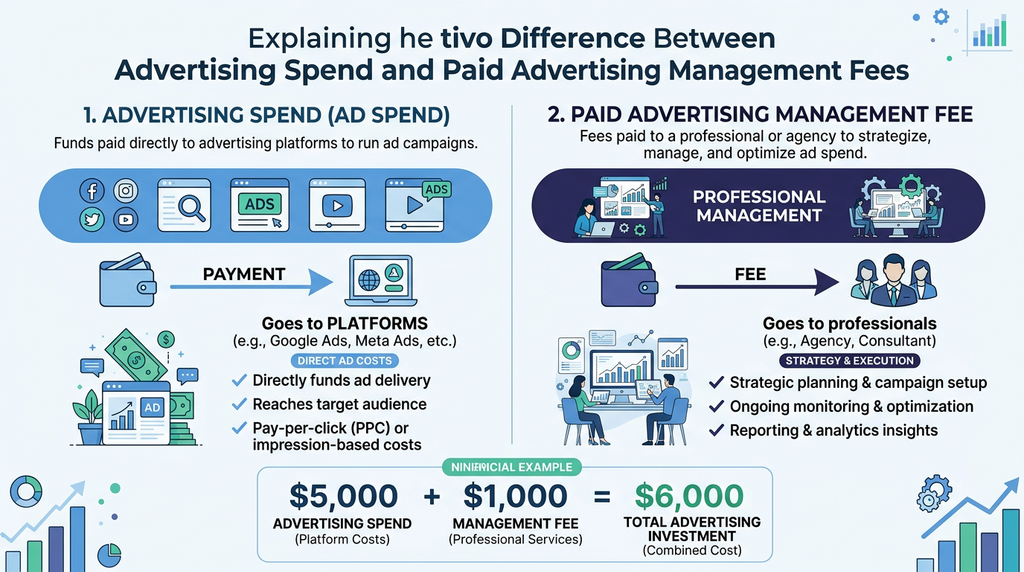
Your advertising budget and your management fee are two different expenses.
If you spend $5,000 with Google Ads and pay an agency $1,000 to manage the account, your total monthly advertising investment is $6,000—not $5,000.
Ad spend vs. management fees
Think of advertising like renting a storefront.
Your ad spend buys exposure on the platform. Your management fee pays the professional who decides where, when and how that budget should be used.
A management service may include:
- Campaign strategy
- Keyword and audience research
- Campaign creation
- Ad copy and creative testing
- Budget allocation
- Bid optimization
- Search-term analysis
- Conversion tracking
- Landing-page recommendations
- Audience management
- Performance reporting
- Ongoing experimentation
Not every provider necessarily includes all of these services. That’s why comparing two quotes based only on the monthly fee can be misleading.
What should a professional service actually deliver?
A good paid advertising provider should be able to explain what happens to your account after you sign the contract.
For example, if an agency charges $1,500 per month, you should understand whether that includes:
- New campaign creation
- Conversion-tracking configuration
- Regular search-term reviews
- Budget adjustments
- Ad testing
- Landing-page feedback
- Performance analysis
- Monthly reporting
- Strategy calls
- Ongoing optimization
If the proposal simply says “PPC management”, ask for the actual deliverables.
How Much Do Paid Advertising Services Cost in 2026?
There isn’t an official U.S. price list for advertising management.
Current 2026 industry pricing data shows a broad range. One current U.S. PPC pricing benchmark places management around $500–$2,000 per month for $1,000–$5,000 in ad spend, $1,500–$5,000 for $5,000–$25,000, and approximately $4,000–$12,000 for $25,000–$100,000 in monthly media spend. Percentage-based models commonly fall around 10%–20% of ad spend, often with a minimum fee.
These should be treated as planning benchmarks, not universal rates.
A simple 2026 pricing example
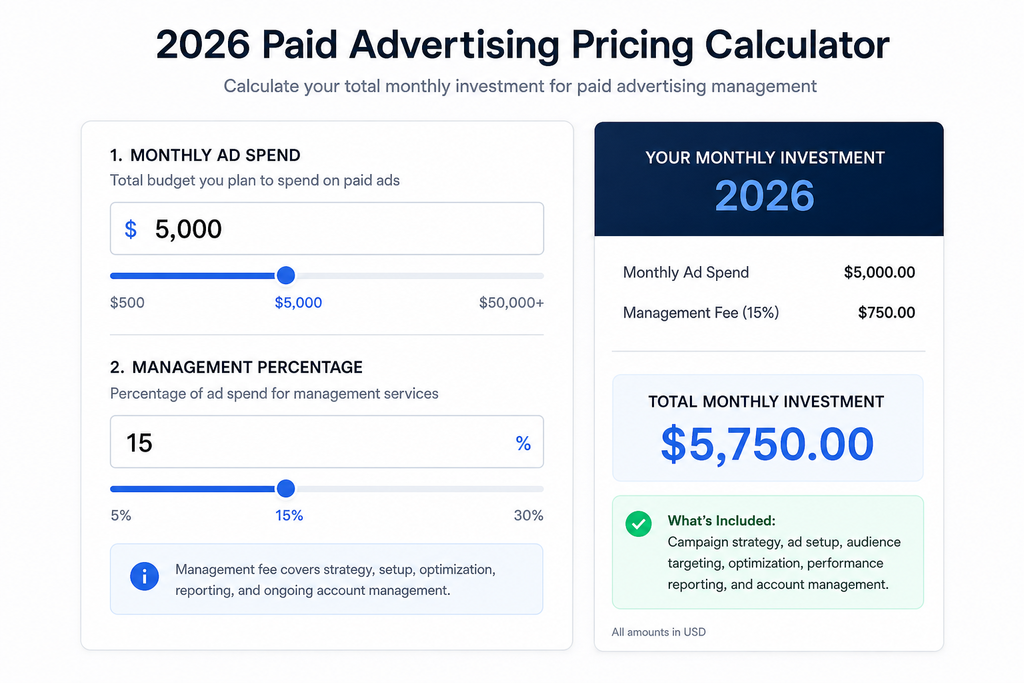
Suppose you have a $5,000 monthly advertising budget.
At a 10% management fee:
$5,000 × 10% = $500
At 15%:
$5,000 × 15% = $750
At 20%:
$5,000 × 20% = $1,000
Your total monthly investment would therefore be:
- $5,500 at 10%
- $5,750 at 15%
- $6,000 at 20%
The percentage alone doesn’t tell you whether the quote is good.
You need to ask what you’re receiving for that money.
Why two businesses with the same ad budget can pay different fees
Imagine two companies each spending $10,000 per month.
Business A sells one service in one city and only needs a few search campaigns.
Business B sells hundreds of products nationwide and runs Search, Shopping, Performance Max, remarketing and social campaigns.
Their budgets are identical.
Their workloads aren’t.
That’s why account complexity can matter more than raw ad spend.
Common Paid Advertising Pricing Models
1. Percentage of ad spend
This is one of the most recognizable agency pricing models.
For example:
$10,000 ad spend × 15% = $1,500 management fee
The model is simple and scales with your budget.
It can make sense when an account requires more active management as spending increases. However, there is an obvious question you should ask:
Does the amount of work really increase in proportion to the budget?
A campaign spending $20,000 isn’t necessarily twice as difficult to manage as one spending $10,000.
That’s why larger advertisers may negotiate lower percentages, tiered rates or hybrid arrangements.
2. Flat monthly retainer
A provider may charge a fixed amount such as:
$1,500 per month regardless of whether your media spend is $5,000 or $7,000.
This makes budgeting easier.
Flat pricing can work particularly well when the workload remains relatively stable. It can also become attractive as advertising budgets grow because the management fee doesn’t automatically increase with every additional dollar spent.
3. Hybrid pricing
A hybrid model combines a fixed fee with a percentage.
For example: $1,000 base fee + 5% of spending above $10,000
This can create a reasonable compromise.
The fixed fee compensates the provider for baseline work, while the percentage accounts for additional scale.
For larger accounts, this structure may be worth discussing.
4. Hourly or project-based consulting
Not every business needs ongoing management.
You might instead hire someone for:
- Account audits
- Campaign restructuring
- Tracking fixes
- Strategy development
- Conversion setup
- Training
- One-time campaign launches
This can be particularly useful if you already have an internal marketing employee who can handle routine campaign management.
What Should Your Business Budget for Paid Advertising services?
Instead of asking, “What does everyone else pay?”, start with three questions:
- How much are we spending?
- How complicated is the account?
- What financial result do we need?
If you’re spending around $2,000 per month
A full-service agency may not always be the most economical choice.
A freelancer, consultant or DIY approach could make more sense if:
- You have one advertising platform
- You have a simple campaign structure
- Your conversion tracking already works
- You can handle some of the work internally
Suppose a provider charges $1,000 to manage a $2,000 advertising budget.
Your management fee represents 50% of your media spend.
That isn’t automatically unreasonable, but it deserves scrutiny.
If you’re spending $10,000 per month
The economics change.
At 10%: $1,000 management
At 15%: $1,500
At 20%: $2,000
A $1,500 fee might be perfectly reasonable if the provider is actively managing multiple campaigns, improving tracking, testing ads and optimizing toward profitable conversions.
If you’re spending $50,000 per month
At 15%, the management fee would be: $7,500
At this level, don’t automatically accept the percentage.
Ask whether the workload justifies it.
You may have enough spending volume to negotiate:
- A lower percentage
- A fixed retainer
- Tiered pricing
- A hybrid arrangement
A practical pricing calculator
Use this basic formula:
Management fee = Monthly ad spend × agreed percentage
Then:
Total advertising investment = Ad spend + management fee + additional service costs
Additional costs might include:
- Creative production
- Landing-page development
- Tracking software
- Call tracking
- Product-feed management
- Photography/video
- Conversion-rate optimization
This gives you a much more realistic view of your advertising budget.
What Should You Get for Your Management Fee?
A management fee should buy more than access to a dashboard.
Strategy and research
Your provider should understand:
- Your target customer
- Your offer
- Your competitors
- Your geographic market
- Your margins
- Your sales process
- Your conversion goal
Advertising doesn’t happen in a vacuum.
A campaign can generate plenty of clicks and still lose money if the offer or sales process is weak.
Tracking and measurement
This is one of the most important parts of paid advertising services.
You should know:
Which campaign generated the lead?
Which keyword generated the customer?
How much did acquiring that customer cost?
Without reliable tracking, optimization becomes guesswork.
For Google campaigns, your setup may involve tools such as Google Ads, Google Analytics and conversion tracking. More advanced businesses may also connect CRM or offline conversion data.
Optimization and testing
An active account should not simply be launched and forgotten.
Depending on the campaign, optimization might involve:
- Reviewing search queries
- Adding negative keywords
- Adjusting bids
- Moving budget between campaigns
- Testing ad messages
- Reviewing audience performance
- Identifying underperforming placements
- Improving landing-page alignment
The exact frequency will vary by account.
Reporting
A useful report should answer:
What happened, why did it happen, and what are we doing next?
A report containing only impressions and clicks doesn’t answer those questions.
For many businesses, more meaningful metrics include:
- Cost per lead
- Cost per acquisition
- Conversion rate
- Revenue
- ROAS
- Qualified leads
- Customer value
How to Evaluate an Advertising Agency Before Hiring
Don’t make your decision based on the proposal’s headline price.
Ask these questions first.
1. What exactly is included?
Get the scope in writing.
2. Who owns the advertising account?
Your business should maintain appropriate ownership and access to its advertising assets.
3. How will conversions be tracked?
If the provider can’t clearly explain this, pause before signing.
4. How frequently will the account be reviewed?
You don’t necessarily need hourly changes. You do need a clear optimization process.
5. What happens if the campaign underperforms?
A good provider should be able to explain how they diagnose problems rather than simply asking you to spend more.
6. Are creative and landing pages included?
Don’t assume they are.
7. Is there a minimum contract period?
Understand cancellation terms before committing.
Red Flags to Watch For
Be cautious if a provider:
- Guarantees a specific number of customers without understanding your business
- Refuses to explain its pricing
- Won’t provide account access
- Reports only impressions and clicks
- Can’t explain conversion tracking
- Uses the same strategy for every client
- Hides additional fees
- Encourages increasing ad spend without explaining expected economics
One particularly important warning:
More ad spend does not automatically mean more profit.
If your campaign isn’t economically viable at $5,000, increasing the budget to $10,000 doesn’t magically solve the problem.
It can simply double the amount of money being lost.
How to Judge Advertising Cost Against Profit
This is where many beginners get confused.
Suppose you spend: $10,000 on ads and pay: $1,500 management
Your total advertising investment is: $11,500
Now suppose those campaigns generate: $30,000 in attributed revenue
Your media ROAS is: $30,000 ÷ $10,000 = 3.0× But your return against the entire advertising investment is:
$30,000 ÷ $11,500 ≈ 2.61× Those aren’t the same measurement.
And neither one automatically tells you whether the campaign is profitable.
Don’t forget your margins
Suppose your $30,000 in revenue produces only $8,000 in gross profit.
You’ve spent $11,500 to generate it.
That campaign doesn’t look attractive.
Now imagine another business generates $30,000 in revenue with $20,000 in gross profit.
The same advertising result could be economically very different.
That’s why ROAS should be interpreted alongside margins, customer acquisition cost and customer lifetime value.
Calculate your break-even CPA
A simplified example:
Your average customer generates $800 in gross profit.
You determine that you can allocate $250 of that amount toward acquiring a new customer.
Your target acquisition cost is therefore approximately: $250 or less per customer
If your advertising consistently produces customers at $180, you have room.
If acquisition costs rise to $400, you have a problem—even if the campaign still produces plenty of sales.
Agency, Freelancer or DIY: Which Is Best?
DIY
Best when:
- Your account is simple
- Your budget is limited
- You’re willing to learn
- You have enough time to monitor performance
Freelancer
Often useful when you want:
- Lower overhead
- Direct communication
- Specialized expertise
- Flexible arrangements
Agency
More appropriate when you need:
- Multiple advertising channels
- Advanced tracking
- Creative production
- Larger-scale campaign management
- Strategic planning
- A team rather than one individual
The goal isn’t to find the cheapest paid advertising service.
It’s to find the arrangement where the total cost of management is justified by the additional value created.
What Makes a Paid Advertising Service “Worth It” in 2026?
Here’s a simple test.
Imagine two providers.
Provider A: $600/month
Provider B: $1,800/month
Provider A sounds better.
But Provider A generates $4,000 in additional gross profit.
Provider B generates $10,000.
The second provider costs three times as much.
Yet the second provider may be the better investment.
This is why you should evaluate paid advertising services using incremental business value, not management fees in isolation.
The right provider should help answer:
Where should we spend?
What should we stop spending on?
Which customers are most valuable?
What can we test next?
What does the data actually tell us?
Those questions are more important than whether an agency charges 10%, 15% or 20%.
Conclusion
There isn’t one “correct” price for paid advertising services in 2026.
For many U.S. PPC accounts, current industry benchmarks place percentage-based management around 10%–20% of monthly ad spend, while flat and hybrid pricing models can make more sense depending on account complexity and workload.
But don’t stop at the percentage.
Calculate your total advertising investment. Understand exactly what the provider will do. Make sure conversion tracking is reliable. Evaluate customer acquisition cost against your margins. And ask whether the service is creating enough additional value to justify its fee.
Most importantly, don’t confuse a cheap management fee with a cheap advertising strategy.
The best paid advertising service isn’t necessarily the one with the lowest price. It’s the one that helps you turn advertising spend into profitable, measurable business growth.
Frequently Asked Questions
How much should I budget for paid advertising services in 2026?
There is no universal budget. A useful starting point is to separate your media budget from the management cost. Current U.S. PPC pricing benchmarks show management fees ranging from hundreds to several thousand dollars per month depending on ad spend and complexity. Percentage-based models commonly fall around 10%–20% of media spend.
Start with what your business can afford to test while keeping your customer acquisition economics in mind. Don’t choose a budget simply because another company spends that amount.
Is 20% too much for paid advertising management?
Not necessarily. A 20% fee could be reasonable for a small, complex or labor-intensive account, particularly when there is a minimum monthly management requirement.
However, on a large account, 20% can become expensive very quickly. For example, 20% of $50,000 is $10,000 per month. At that scale, it’s reasonable to discuss flat, tiered or hybrid pricing.
The key question is what work are you receiving for the fee?
Should I hire an agency if my advertising budget is only $2,000 per month?
Not automatically. With a $2,000 budget, an agency’s minimum retainer could consume a significant portion of your total marketing investment.
Depending on your campaign complexity, a freelancer, consultant or carefully managed DIY approach may be more economical.
Before hiring anyone, calculate:
Ad spend + management fee = total monthly investment
Then determine how many additional customers you need to make that investment worthwhile.
How can I tell whether a paid advertising service is actually profitable?
Start with customer acquisition cost and gross profit, not clicks alone.
For example, if you spend $10,000 on advertising and $1,500 on management, your total advertising investment is $11,500. If those campaigns produce $30,000 in revenue, you need to look beyond the 3.0× media ROAS and determine how much gross profit remains after product, fulfillment and other costs.
A campaign is successful when the economics work for your business—not simply because the dashboard contains impressive-looking numbers.



Pingback: Google Ads Agencies: Are They Worth It? The Real Numbers
Pingback: 10 Best Tools for Marketing Automation for Small Businesses in 2026 (Tested & Compared) - Moneticks