

Real Estate Lead Generation in 2026: 15 Strategies That Actually Get Clients
Ever felt like you’re throwing darts at a dartboard with a hole in the middle? You run a Facebook ad, get 40 form fills, and by the time you follow up half of them can’t remember filling out the form! Are you making these mistakes?
In 2026, real estate lead generation is about more than just quantity and less about vanity metrics. It’s about getting the right leads in the first place, and keeping the leads you do get from slipping away due to poor follow-up, sloppy data entry, or a simple TCPA violation that will cost you $1000 per violation.
I’ve been in this industry for over 10 years and seen agents waste countless hours chasing irrelevant leads while the deals they could have had slipped through their fingers because they didn’t follow up fast enough, didn’t use a referral network, or didn’t keep good records.
In this guide, I’m going to show you the 15 most effective lead generation tactics that worked in 2026, organized into the 4 pillars of a lead generation system. Let’s get started.

Table of Contents
What makes Real Estate Lead Generation Looks Different in 2026?
The referral economy reigns supreme
According to the National Association of REALTORS’ 2025 Profile of Home Buyers and Sellers, 43% of buyers found their agent through a friend, neighbor, or relative, and 49% of first-time buyers found their agent this way. Add in the 15% of buyers who returned to an agent with whom they had previously worked, and that’s 58% of buyer-agent connections, overall. Meanwhile, only 7% of home buyers found agents by inquiring about a listing they found online.
That doesn’t mean digital marketing isn’t valuable. It means your digital marketing has to effectively drive to the referral economy.
What’s changed this year
There are two big trends shaping the way agents connect with buyers or sellers in 2026:
TCPA enforcement is cracking down on telemarketing, after the FCC approved “one-to-one consent” for robocalls and texts in April 2025, with compliance due in January 2026. That means if you use an auto-dialer, AI voice calling, or ringless voicemail drop services, you’ll need to have individual consents on file for every lead, or be prepared to pay a fine of $500 to $1,500 per violation.
AI-assisted response and data automation have become mainstream, and instant follow-up is now the norm, not the exception.
Both of these changes highlight why your real estate lead generation in 2026 has to focus on creating a compliant, defensible process.
Referral & Reputation-Based Strategies (1-4) (Article)
Develop a systematic process for requesting referrals
Most agents request referrals in an ad hoc fashion. Usually, it’s once — maybe twice — at closing. Instead, develop a systematic approach by asking at closing, plus at the 30-day post-closing touch base, and finally, at the one-year anniversary. Make asking for a referral simple by providing a boilerplate message for them to send to their network (you can even give a small gift card or make a donation to their favorite charity if your state allows). NAR data shows that 91 percent of past clients would use or refer their agent again, and 62 percent had already referred their agent within the first year. This means we’re not generating demand, we’re harvesting demand!
Execute a win-back campaign for your past clients
Your CRM likely has a wealth of past clients who haven’t bought or sold in 18+ months. Reach out to them with a simple market update and/or home value update email. As mentioned in #1, 41 percent of repeat buyers found their agent via referral, and another 18 percent simply went back to the agent they used previously, meaning that they’re still our highest-yielding lead source. We just need to stay in front of them.
Optimize your Google Business Profile
Consumers are far more trusting of reviews than a nicely made website. In addition to making sure your Google Business Profile is optimized, engage with your reviews on a regular basis. Post service area updates, photos, answer questions, and respond to reviews AFTER closing to let prospective clients know you’re a trustworthy, responsive resource.
Generate agent and lender partnerships
Agent-to-agent referrals comprise roughly 7 percent of buyer agency relationships — and can be much higher in relocation-focused markets. Build partnerships with agents in your feed markets, loan officers, and relocation specialists. A referral agreement (documented and signed by both parties) will keep you on the right side of the law and ensure a consistent stream of business from partnership leads.
Digital & Content Marketing Strategies (5–9)
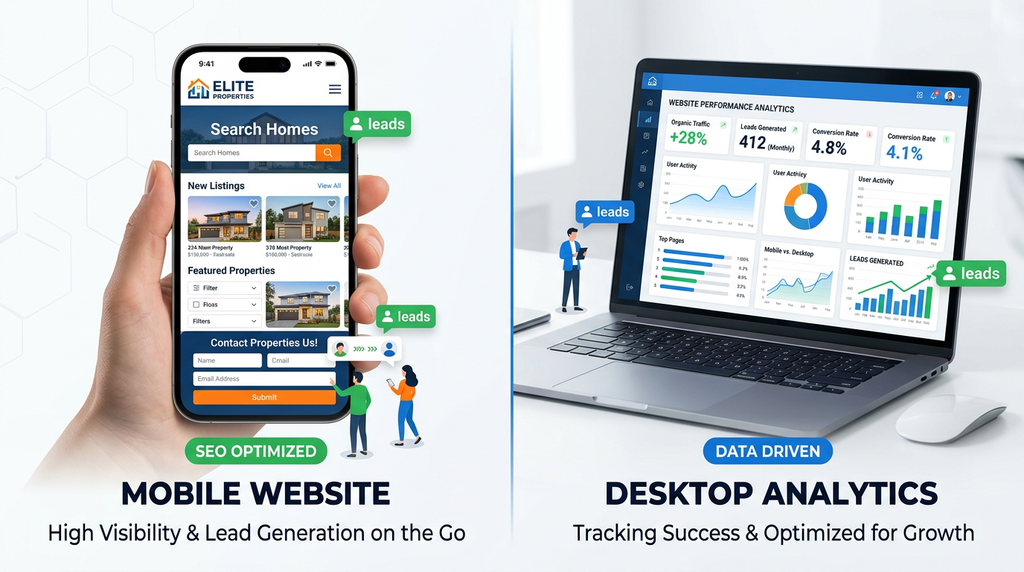
Build out an SEO-optimized IDX website
That surfaces or rank for terms like for “[your city] homes for sale” and “best neighborhoods in [city] for families,” with a focus on:
- Fast, mobile-first design
- IDX/MLS integration so that listings update automatically
- And individual landing pages for every neighborhood or ZIP code
As a long-term lead generation play, SEO tends to have a slow burn but exceptional ROI once it starts converting.
Leverage short-form video content
There’s a reason that Reels, TikToks, and YouTube Shorts get so much engagement: walkthroughs of your best properties, “$400K buys you…” style videos, and local market overviews create value and drive traffic far more effectively than any other content format. Don’t worry about high production value, just ensure that the hook is scannable on a phone.
Paid ads (Google LSA, Meta lead generation)
Still effective if you’re willing to send people to a lead capture page (not your main site URL), follow up with them in a timely fashion (ideally the same day), and have a clear value proposition for why they should work with you.
Lead nurturing sequences (email/SMS)
If someone isn’t going to buy tomorrow, you need to stay on their radar in a non-intrusive way. That’s what drip campaigns are for: a series of emails or texts sent over weeks or months that remind prospects that you’re here when they’re ready to buy. Segmentation is key, since an investor prospecting in the 48905 ZIP code isn’t looking for the same thing as a first-time homebuye
Hyperlocal content creation
On your site. Neighborhood guides about schools, property taxes, and best restaurants in the area are great for SEO and establishing you as an authority in your market.
Compliance, Automation & the Tech Stack That Protects Your Pipeline (10–13)
This section is the one where most agents and brokers fail to comply with the regulations resulting in potential losses of a deal or license.
TCPA Compliance Before Calling a Lead
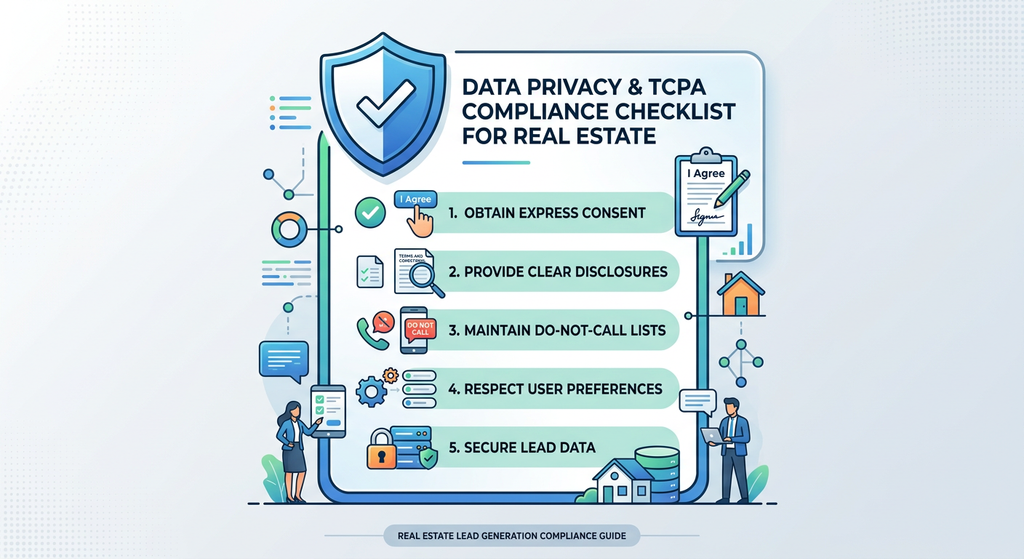
If the real estate agent uses an automatic dialer or an artificial intelligence voice message to contact the leads, it must have an express consent from the client, according to the updated FCC Telephone Consumer Protection Act (TCPA). In particular, the companies should request the written permission from the lead they are contacting to leave a message using a specific method (phone, SMS, etc.) and make sure the contact is not on the National Do Not Call Registry. The agent/broker should be able to demonstrate the express consent when calling any lead or sending a marketing SMS/email. One way to do that is to equip the lead generation forms with a checkbox and an e-signature field. In addition, the calls should have a timestamp to prove that the conversation happened. The TCPA-compliant real estate CRM (customer relationship management) software can automatically score the leads and send them reminders about the call based on the agreement date.
CRM Compliance Tools
The real estate CRM compliance tools can help in automating the majority of lead generation tasks. First of all, choosing the right CRM for your business means you will be able to score your leads and send relevant messages without having to check each lead’s TCPA compliance status and documents. Note that the same automation tools can be used in the lead nurturing process to remind the clients about an upcoming meeting, schedule a call with them, or send a gentle CTA (call to action) to set up a meeting.
Data Privacy Management Tools
In addition to TCPA-compliant tools, real estate agents and brokers should consider using personal data privacy management solutions. They will allow the users to collect and store the data in accordance with the Privacy Rights initiative launched in California (CPRA). At present, several states are considering similar personal data privacy laws, and there is no doubt that TCPA and CPRA will expand to other areas in the future. It would be expensive and time-wasting for a small business to develop a proper data management solution compliant with all requirements, but there are some affordable tools that offer turn-key data privacy management solutions for small businesses.
GRC Tools for Real Estate Agents
Using GRC (Governance, Risk, and Compliance) tools is mandatory for most large-scale organizations but is still an option for small and medium-sized brokerages. In this case, the automation tools can help in creating a standardized approach to leads and referrals management across the board. All the information about lead generation sources, referral sources, and individual lead/referral details (consent to market, consent to contact, etc.) should be available in one place and up-to-date at all times. Some GRC software can offer automated solutions in terms of lead/referral management while others are aimed at providing the necessary information to one individual (agent/broker).
Advanced & Emerging Strategies (14–15)
14. Advanced: Consider Chatbots for Instant Response
A chatbot that can answer simple questions and request contact information on your website at 11 p.m., when 40% of listing browsing activity occurs, is a significantly better lead-capturing tool than losing an agent to a competitor’s faster response the next morning. Ensure that the chatbot’s lead capture process includes the right scripting and consent language to tie into strategy #10.
15. Consider Using Geofencing and Retargeting
The use of geofencing technology to trigger location-based retargeting advertisements is an increasingly cost-effective way to reach prospective clients. By targeting smartphones that have been in a location (such as one of your open houses or a competitor’s listing), you can create more surgical and relevant ad campaigns than using large demographic categories. A follow-up SMS campaign to these prospects can also be appropriate, assuming that you have obtained the required TCPA consents as described in strategy #7.
Conclusion
As you can see, real estate lead generation in 2026 is not a matter of identifying and deploying one flashy tactic or technology. The most successful agents in the next five years will feature a robust referral generation system, supported by appropriate digital content and a comprehensive but compliant technology platform. In all cases, make sure that your lead generation activities are designed with TCPA and other legal compliance requirements in mind, or you could waste a significant amount of time and money on campaigns that cannot be fully utilized or may get you into trouble. By focusing on these foundational tactics, you will find that your time spent on lead generation efforts is far more productive – in terms of closing rate and overall revenue – than you might expect.
Frequently Asked Questions
1. What is the most effective lead generation technique for a new real estate agent in 2026?
A new agent with no existing clientele should focus their efforts on building a Google business profile and creating short-form video content for their local area. It requires little investment beyond their time, and will develop the reputation and trust that a real estate agent needs to get referrals.
2. Do I need compliance software if I am a solo agent or small team?
If you are using any type of dialer, texting service, or purchased lead lists, then yes, compliance software is necessary. The new TCPA rules mean violations result in expensive lawsuits, with penalties starting at $500 per affected party, and going up to $1,500 for each violation if the court finds you intentionally violated the rules. Purchasing a compliance software subscription for a small team would be much less expensive than dealing with a lawsuit.
3. How long does SEO take to produce results for real estate lead generation?
Most experts will tell you between 4-8 months before an SEO campaign will begin to show results in terms of higher rankings for keywords related to real estate. It may take longer (up to 12+ months) to rank for more competitive keywords. SEO is not something that will give you results overnight, but it is a worthwhile investment to draw in more qualified leads over time.
4. Are purchased leads (Zillow Premier Agent, BoldLeads, etc.) a good value in 2026?
Purchased leads can be a good value, but they typically have a much lower conversion rate than referral leads or SEO leads. It is also important to make sure that whichever company you purchase from actually has the right TCPA consent before contacting any leads, as you could be liable for any violations that may occur if you do not do due diligence.
5. What is the difference between a CRM and a GRC/Compliance platform/software?
CRM stands for Customer Relationship Manager, and typically focuses on managing and organizing interactions with prospects and customers. GRC stands for Governance, Risk Management, and Compliance, and focuses on making sure that an organization is operating within the law. While there is some overlap, most experts believe that the two systems should be used in tandem. Larger organizations may need to use both systems, with the CRM being linked to the GRC so that contact attempts by salespeople will be blocked if there is no proof of TCPA consent.