

Are Google Ads Agencies Worth It? The Real, Proven Numbers
A Google Ads agency can become one of your company’s most profitable investments, or an expensive middleman that makes attractive reports while your budget quietly disappears.
It’s tough to hear, but the truth is what makes Google Ads successful usually boils down to three key things. However, these are how much you’re spending on ads. They include the fees for management and the value you get from each conversion.
For Google Ads Agencies, what an agency should do, though, is help you make smarter decisions about your campaigns.
Specifically, choose which searches to target and how much to bid. Also decide where to send your traffic and how to turn clicks into customers.
So, are Google Ads agencies worth it? Sometimes yes. Sometimes absolutely not.
The honest answer depends less on the agency’s sales pitch and more on your numbers. In this guide, we will look at realistic costs, break-even calculations, agency pricing models, and the situations where outsourcing paid search makes financial sense for a U.S. business.
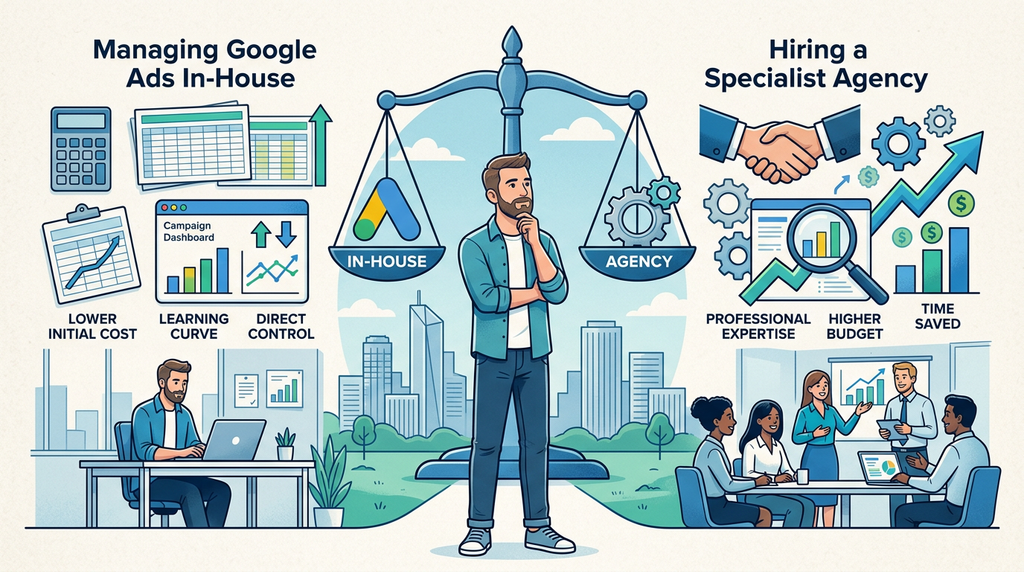
Table of Contents
What are the things does Google Ads Agency Actually Do?
A professional Google Ads agency should do much more than create a few ads and increase your daily budget. Its job is to connect paid traffic with measurable business results.
Campaign strategy and account structure
Before spending money, an agency should understand:
- What products or services you sell
- Which customers are most valuable
- Your geographic service area
- Your average order value or your customer’s lifetime value
- Your acceptable cost per lead or acquisition
- Which conversions matter to the business
For instance, a company that fixes pipes might want to get phone calls from people who live close by, like within 20 miles of their office. On the other hand, a company that sells things online might care more about how much money they make from each order, rather than just how much they sell. And a company that makes software for other businesses might be more interested in getting demos from the right people, rather than just getting people to fill out forms.
These businesses should not use the same campaign structure.
A good advertising agency can help you organize your campaigns in a way that makes sense, like by service, location, or type of product. They can also use something called negative keywords to make sure your ads don’t show up when people search for things that aren’t relevant to your business. It might sound like complicated stuff, but it’s actually really important for making sure your advertising budget is being used in the best way possible. This way, you can get the most out of your money and reach the people who are most likely to be interested in what you have to offer.
Conversion tracking and landing pages
Lots of companies think their Google Ads are doing a great job just because they’re getting form submissions. But here’s the thing: some of those forms might be spam, or maybe they’re duplicate inquiries, or possibly they’re just low-quality leads that aren’t really worth much.
To really make sure everything is set up right, an agency should use tools like Google Ads conversion tracking, Google Analytics, call tracking, and CRM integrations to get accurate tracking in place. For businesses that focus on generating leads, it’s not just about getting a lot of leads, but rather getting qualified leads that actually turn into paying customers, which is often the most important metric to track.
A good landing page is really important. If you send everyone to your main homepage, it can actually hurt how well your campaign does. A landing page that’s focused on one thing usually has a few key elements that make it work well.
- One clear offer
- A relevant headline
- A visible call to action
- Trust signals, reviews, or guarantees where appropriate
- Fast loading performance
- A mobile-friendly layout
An agency cannot rescue every weak offer. If your pricing, service, or sales process is noncompetitive, better targeting will only expose the problem faster.
Ongoing optimization
Google Ads is not a set-it-and-forget-it channel. Search behavior changes, competitors adjust bids, and new irrelevant queries appear.
Ongoing agency work may include:
- Reviewing search-term reports
- Adding negative keywords
- Testing ad copy
- Adjusting bids and budgets
- Improving Quality Score
- Testing landing pages
- Segmenting audiences and locations
- Analyzing calls and CRM outcomes
- Pausing campaigns that do not meet business goals
The value is not the number of changes made. The value is whether those changes improve profit, qualified pipeline, or customer acquisition efficiency.
The Real Cost of Hiring a Google Ads Agency
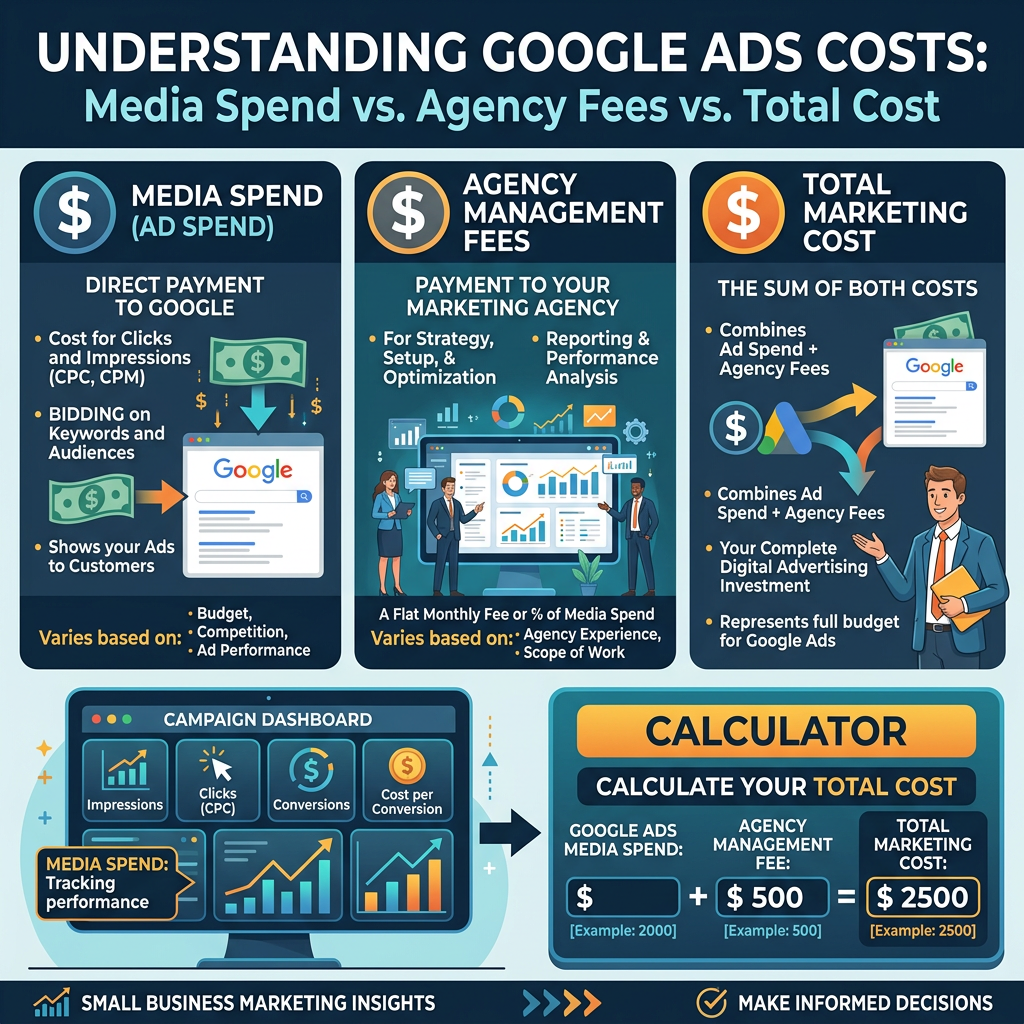
The first financial mistake is confusing your advertising budget with the agency’s fee. They are separate costs.
Ad spend versus management fees
Suppose your business spends $5,000 per month directly with Google. If the agency charges 15% of ad spend, its management fee would be $750. Your total monthly marketing cost becomes:
Google Ads spend: $5,000
Agency management fee: $750
Total: $5,750
Some companies charge a one-time fee to get things started, which can include things like reorganizing your account, tracking conversions, researching keywords, and suggesting improvements to your landing pages. Others might charge a fixed monthly fee instead of taking a percentage of your spending.
Common pricing models include
The amount spent on ads is usually around 10 to 20 percent, but this can vary depending on the size of the account and the level of service provided.
Flat monthly retainer: A fixed fee, such as $1,000 to $5,000 or more.
Hybrid pricing: A smaller base fee plus a percentage of spend.
Performance-based pricing: Less common and usually tied to specific lead or revenue targets.
A low management fee is not necessarily a bargain. A $300 monthly fee may look appealing, but it may only cover basic monitoring. A higher fee can be reasonable if the agency provides strategy, tracking, landing-page testing, creative work, and meaningful business analysis.
A realistic monthly example
Imagine a local legal services firm with this monthly budget:
Ad spend: $8,000
Agency fee at 15%: $1,200
Total marketing cost: $9,200
Average qualified lead value: $2,500 in expected gross profit
Target cost per qualified lead: $500
When you break it down, the numbers look pretty good – if the campaigns bring in 20 qualified leads, it works out to $400 per lead, which seems like a strong result. However, things get a bit more complicated when you factor in the agency fee, because that bumps the cost up to $460 per qualified lead.
That distinction matters. Agencies should report both:
Media-only performance
All-in performance, including management fees
If that’s the case, the account might look like it’s doing better than it actually is.
The Numbers: When Can an Agency Become Profitable?
Looking at industry benchmarks can give you an idea of how things are going, but they can’t tell you exactly how your business will do. For example, WordStream’s analysis of over 13,000 US search advertising campaigns in2026 found that, on average, ads got clicked 6.64% of the time, cost $5.42 per click, converted 8.18% of the time, and cost $66.69 per lead.
But these are just general numbers – they don’t mean your business will get the same results. Every business is different, and what works for one company might not work for another. So, while benchmarks can be helpful, they’re not a guarantee of success. You need to look at your own numbers and figure out what’s working and what’s not.
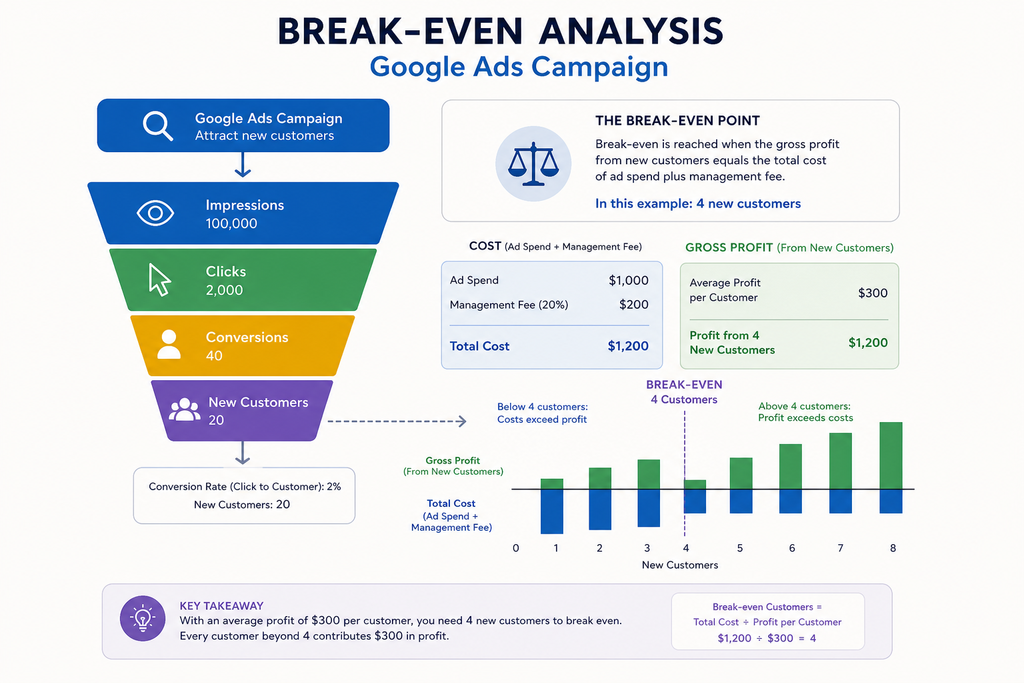
A simple break-even formula
Use this formula to estimate whether outsourcing could work:
Break-even customers = Total monthly marketing cost ÷ profit per new customer
For example:
Ad spend: $3,000
Agency fee: $600
Total cost: $3,600
Gross profit per new customer: $900
You need four new customers to break even:
$3,600 ÷ $900 = 4 customers
If the business closes 10 customers from the campaign, the economics may be attractive. If it closes only two, the campaign loses money—even if the cost per lead looks impressive.
Cost per lead is not the same as profitability
What one company thinks is a lot to pay for a lead, another company might think is a bargain. It really depends on the business and what they’re selling.
Consider two companies:
Company A earns $120 in gross profit per sale and converts 10% of leads.
Company B earns $4,000 in gross profit per sale and converts 10% of leads.
Company B can afford to pay far more per lead. That is why an agency should ask about lead quality, close rate, gross margin, and lifetime value, not just clicks and impressions.
Why averages can mislead you
Google Ads performance varies significantly based on:
- Industry competition
- Location
- Keyword intent
- Brand recognition
- Offer quality
- Sales-team performance
- Website conversion rate
- Seasonality
- Customer lifetime value
A high CPC may still be profitable if the search intent is strong. A cheap CPC may be worthless if the traffic comes from people who are only researching or looking for free information.
Use benchmarks as a question generator—not as a promise.
When Is a Google Ads Agency Worth It?
You sell high-value products or services
Outsourcing often makes more financial sense when one new customer is worth several hundred or several thousand dollars. Examples may include:
- Home remodeling
- Legal services
- Medical and dental practices
- B2B software
- Commercial services
- High-ticket education
- Specialty financial services
With higher customer value, you have more room to pay for expertise, testing, and management.
Your team lacks paid-search experience
Google Ads has a learning curve. Mistakes involving match types, conversion tracking, location settings, bidding strategies, or search partners can waste money quickly.
An agency may be worthwhile if your internal team does not have time to:
- Review performance consistently
- Investigate search queries
- Test landing pages
- Connect ad data to sales results
- Keep up with platform changes
You are not merely paying someone to click buttons. You are paying to shorten the trial-and-error cycle.
Your account has enough budget for testing
An agency needs enough data to make informed decisions. If you spend only $300 per month in a highly competitive market, the account may generate too few clicks and conversions to support reliable testing.
Using Google Ads can still be a good idea for small businesses, but it’s essential to have realistic expectations. Instead of trying to cover too much ground with a limited budget, it might be more effective to focus on a specific service or location. This approach can help you make the most of your resources and avoid spreading yourself too thin across multiple campaigns. By concentrating on one key area, you can create a more targeted and efficient advertising strategy that yields better results.
Your current account is wasting money
An audit can reveal problems such as:
- Ads showing outside your service area
- Broad search terms attracting irrelevant traffic
- Missing call tracking
- Duplicate or poorly organized campaigns
- Budget assigned to low-value keywords
- Conversion actions counting page views as leads
- No negative keyword process
Finding and fixing expensive leaks can actually save an agency so much money that it covers the cost of the fee itself.
When Managing Google Ads Yourself May Be Better
Hiring an agency is not always the right decision.
You may be better off managing campaigns internally when:
- Your monthly budget is very small
- You have a simple, narrow product catalog
- You already have an experienced marketer
- You can review performance weekly
- Your business has strong analytics and CRM systems
- You need close control over messaging and promotions
You can also begin in-house and outsource later. This approach lets you learn your customers, offers, and economics before asking an agency to scale the account.
How to Choose the Right Google Ads Agency
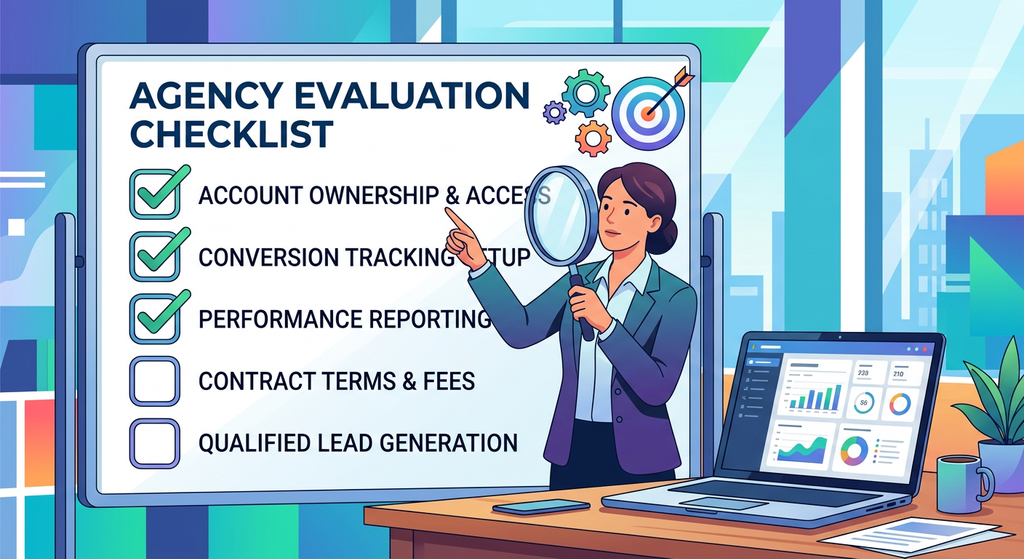
Ask these questions before signing
A reputable agency will be open about all of the following:
- Who owns the Google Ads account, and who can access it as an administrator.
- How conversions are defined, and whether phone calls and qualified leads are tracked.
- What the monthly fee covers – optimization services, analytics, and account management.
- How often the account will be optimized by the agency.
- Whether the contract includes a cancellation clause.
- Whether the agency has experience with similar businesses – request anonymized case studies.
- How the success rate is calculated.
- Whether landing page and creative services are offered and billed separately.
Ownership of the account and access to data is another crucial point. In case an agency refuses to provide this, it should raise your suspicion.
Watch out for false promises
If a Google Ads company makes any of the following promises, ask yourself the right questions:
They guarantee a certain amount of leads without analyzing your market.
They promise a fixed ROI.
They claim to make the account profitable right away.
They advertise cheap clicks or simply want to sell inventory.
They may promise to appear in the #1 position in Google for all keywords.
Google Ads competition varies a lot from niche to niche and region to region. A competent Google Ads agency will always provide a detailed report outlining the assumptions, risks, and timelines.
Demand proper reporting
Google Ads agencies should give you a detailed monthly report outlining the most important metrics. Here’s what to look for:
- Overview of the spending and budget vs actuals.
- Number of conversions and qualified conversions.
- Cost per qualified lead.
- Sales/revenue, if applicable.
- Overview of the search terms and optimizations.
- A list of experiments and future plans.
- Issues that require your attention.
A colorful report is nice to look at, but it says little about the performance of your campaign. Ask the agency to explain exactly what has changed.
Conclusion
A Google Ads agency is a worthwhile investment if their work generates more profit than the combined cost of the ads and the agency’s management fee. This depends on the value of the closed deals, the average revenues, the likelihood of a sale, and the profit margin.
Google Ads agencies are usually the best option for premium accounts, complex cases requiring optimization expertise, and companies without a dedicated growth team. For simple accounts and small budgets, in-house management may be more efficient. Make sure to calculate the break-even point before hiring an outside agency.
Before signing the contract, request transparency, obtain account access, and make sure the agency knows how to drive profitable growth. A competent agency will help you get more out of your Google Ads by making your marketing more quantifiable and focused on conversions.
Frequently Asked Questions
How much does a Google Ads company charge?
Most agencies operate on a percentage basis – 10% to 20% of the managed ad spend. Some Google Ads agencies offer transparent monthly billing – either fixed-rate management or a combination of fixed and variable fees. You may also be asked to pay a one-time setup or audit fee. Make sure to clarify whether the advertised rate includes conversion tracking, landing page optimization, calltracking, tracking setup assistance, and reporting.
What is considered as to be a good ROI for Google Ads?
There is no such thing as a good or bad ROI for Google Ads. It all depends on the profit margin of your average deal and how much revenue you are able to secure. For example, a 300% ROI can be terrible for a low-margin dropshipping business and fantastic for an enterprise account with monthly recurring revenues.
How long does it take for Google Ads to show results?
It all depends on your niche, budget, and sales process. With a properly structured Google Ads campaign, it is possible to get leads in days. However, it takes several weeks to understand which variations yield better results, how qualified the leads really are, and whether there is enough demand at a given budget. A Google Ads agency should work with you to set realistic expectations.
Should a small business consider investing in Google Ads?
A small business should invest in a Google Ads agency if one customer’s profit margin is high enough to justify the management fee. At the same time, if the budget is too small to allow experimenting and testing variations, it may make sense to go with a more conservative in-house campaign. The decision should be made on a case-by-case basis with an analysis of your average deal size and overhead expenses.
What to do if a Google Ads company is not working?
Request a detailed performance report. Compare the numbers to your CRM and sales data. Does the campaign really acquire new customers? Is the agency targeting the right regions? Has the company used any optimizations? Ask for a detailed performance improvement plan. If nothing works out, ask to cancel the service. You have every right to leave if you cannot understand how the money are spent.
Always remember that you are the official owner of the account. If an agency refuses to provide information or account access, consider this a red flag.



Pingback: Paid Advertising Services: How Much Should You Actually Pay in 2026? - Moneticks
Pingback: Pay Per Click Advertising: Google Ads, Costs, Benefits, and Best Practices - Moneticks