
Pay Per Click Advertising: Google Ads, Costs, Benefits, and Best Practices
You search “best dentist in Chicago.” Within milliseconds Google holds an auction, selects the winners, and displays sponsored links at the top of the page. These links are purchased by advertisers using pay per click advertising and show up in the search results because of the clicks – and thus the money – you will give them. That is the brilliance of pay per click advertising. You do not pay for eyeballs, impressions or some nebulous concept of brand exposure. You pay for someone who is interested in what you have to say.
But there is an uncomfortable truth that many beginner guides to pay per click advertising will hide from you. Paying per click does not always mean paying for results. A Chicago dentist could spend $4,000 on ads and get hundreds of clicks without any new patients because they had a poor targeting strategy, weak landing pages, or faulty tracking setup.
This guide will tell you all that you need to know about the inner workings of Google’s auction process and give you an honest assessment of what pay per click advertising can and cannot do for your business. You will also discover what most U.S. companies are paying for pay per click advertising in 2026 and exactly what you should be trying to accomplish with your campaigns.
Table of Contents
What Is Pay Per Click Advertising, Really?
Pay per click advertising is a digital advertising model in which advertisers are charged a fee for every click that brings traffic to their website. Seems simple enough, but the reality is much more nuanced.
Think of pay per click advertising as buying a billboard on the busiest road in your city, but instead of paying a set rate for the space, you only pay when someone pulls up to the billboard, stops, and reads the advertisement. The upside potential is enormous, but the execution is everything.
How the Auction For Your Ad Works
Every Google search is actually an auction that takes place in milliseconds. Google does not reward the highest bidder by giving them the top ad spot. That is one of the myths of pay per click advertising
Google has a complex formula that values each advertiser’s bid and determines which ads will appear based on three main criteria.
- Your maximum cost per click bid.
- Your Quality Score which is a 1–10 value based on your bid, click-through rate, and relevance of your ad and landing page.
- The expected impact of your ad extensions which are additional links and information that appear with your ad.
An advertiser with a $3 bid and a Quality Score of 9 can outrank a competitor bidding $7 and a Quality Score of 4 would beat you with a higher bid and a 3 because Google values relevant ads more than higher bids.
Your cost per click will typically be lower than your maximum cost per click bid because you only pay enough to beat the advertiser below you for the specific ad position.
PPC vs Organics search: The Big Difference
Organic search results earn their spot on the page through hard work and dedication. They provide long-term value to websites and are the backbone of any successful SEO strategy. With pay per click advertising, traffic comes the moment the campaign turns on and disappears the moment it is turned off.Neither is universally better. Here is when each makes more sense:
| Situation | PPC Advantage | SEO Advantage |
|---|---|---|
| New business, no website authority | ✅ Immediate visibility | ❌ Months to rank |
| Competitive keyword with high commercial intent | ✅ Can appear above organic results | ❌ Difficult to displace established pages |
| Long-term content and brand building | ❌ Cost never stops | ✅ Compounding returns over time |
| Time-sensitive promotion or event | ✅ Launch and pause on demand | ❌ Cannot rank quickly |
| Limited budget | ❌ Budget exhausts quickly | ✅ Lower ongoing cost |
The smartest strategy often combines both. PPC closes short-term gaps while SEO builds sustainable traffic over time.

How Google Ads Works for U.S. Businesses Essay
This feature is for the U.S. Only: Google Ads Makes Up Approximately 28% of U.S. Digital Ad Spending (eMarketer, 2025). That’s why analyzing the mechanics of the tool before any expenditure is crucial in order to avoid common budget wastage pitfalls.
Types of Google Ads
There are several distinct types of advertising available via the Google Ads matrix:
- Search – the ads appear in the search results for specific keywords. Search ads have one of the highest rates of engagement since they appear for the most relevant search terms.
- Display – display ads appear across a range of websites within the Google Display Network
- Shopping – appear alongside the relevant products
- Performance Max (PMax) – a set of Google’s AI-driven campaigns that use the company’s data and technologies to distribute the ads across multiple platforms at once. This option is technically the most difficult to manage due to the complexity of it.
- YouTube (Video) – appear on the video platform before relevant videos begin
The majority of beginners are better off using search ads to advertise since they are the most conservative in terms of expenditure prediction.
Advertising Performance: The Most Important Metrics to Follow
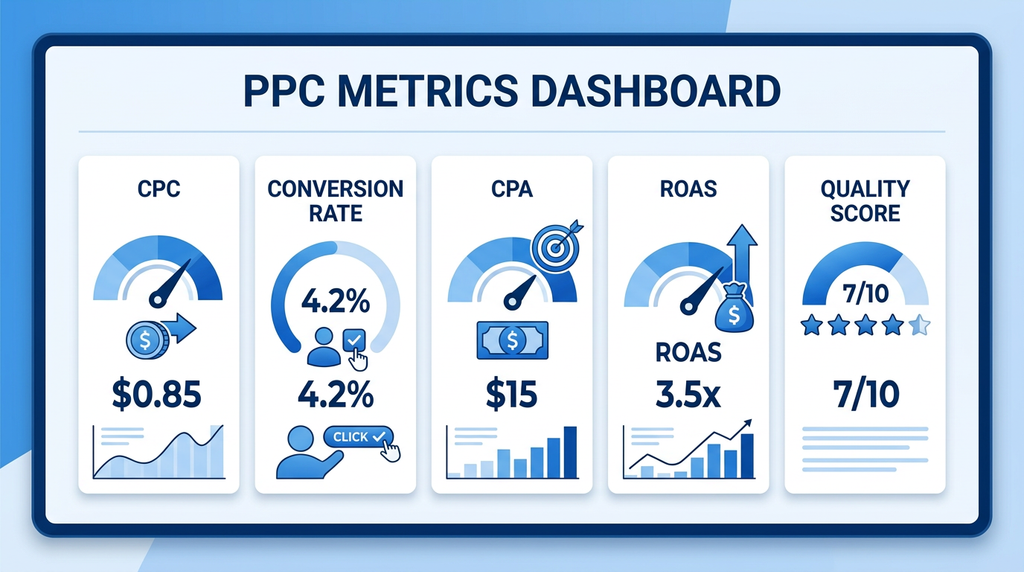
The thing about advertising is that metrics can be very misleading. The two most common ones that beginners track are impressions and clicks. However, neither of these is a useful metric that indicates the success or failure of an advertising campaign. Instead, it is important to follow several other figures:
Cost per click (CPC), Conversion Rate, Cost per Conversion (CPA), Return on Ad Spend (ROAS), Quality Score. The last metric, Quality Score, is actually a figure used internally by Google to indicate whether the ads are relevant to the audience.
It is vital to understand the context of each metric. A 4% conversion rate with a $45 cost per lead in the legal services industry might be outstanding. The same numbers for a $15 product for an e-commerce store would be considered a catastrophic failure, for example. That is why the figures should never be taken out of context.
How Much Does Pay Per Click Advertising Cost?
This question presents a conundrum since the answer always depends on the factors involved. There are a number of things that determine how much an advertiser will have to spend on a pay-per-click basis.
Some of the most common and influential factors per the WordStream 2026 Google Ads Benchmark Report (data collected from over 13,000 U.S. advertiser accounts between April 2025 and March 2026) are the following:
Vertical – the cost per click (CPC) for local home services is significantly lower than for high-priced niches such as personal injury. For instance, an average CPC for a personal injury lawyer in the U.S is $5.42, with an average conversion rate of 8.18% and an average cost per lead of $66.69.
| Industry | Average CPC (U.S.) | Average Conversion Rate |
|---|---|---|
| Legal services | $9.21 | 7.00% |
| Home improvement | $6.55 | 9.20% |
| Healthcare & medical | $8.62 | 5.89% |
| E-commerce (retail) | $3.84 | 4.01% |
| Education | $5.01 | 6.20% |
| Finance & insurance | $8.99 | 5.10% |
Area of operation: the competition between local advertisers within the same area can push up the overall cost of the campaign.
Quality Score – the relevance of the keyword and the quality of the landing page impact the score significantly
Match type – broad match keywords will have more impressions but a lower CPC than the phrase match and exact match.
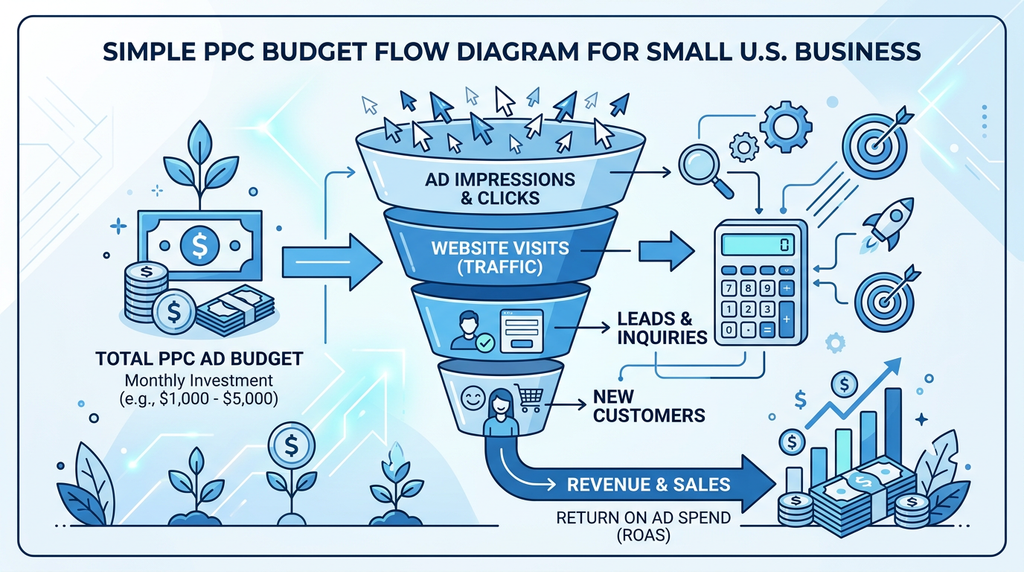
An Example of Pay Per Click Advertising Budget
Assuming that an individual wants to open a home remodeling business in Dallas, they would most probably advertise remodeling services. The analysis of the average CPC for remodeling services in Dallas, TX, would provide a rough estimate of the required budget for an individual.
The calculation for the remodeling company would be as follows:
– An average cost per click (CPC) is $7.00
– Budget: $2,100
– Estimated clicks per month: 2,100 / 7 = 300
– The conversion rate for remodeled pages is 8% = 300 0.08 = 24
– Assuming that the remodeling company only offers kitchen remodeling and each kitchen remodel generates $3,500 in gross revenue, the revenue per month is 24 0.25 $3,500 = $21,000
– Number of new customers: 24 0.25 = 6
– Gross revenue from new customers: 6 $3,500 = $21,000
– Expenditure: $2,100
– ROAS: $21,000 / $2,100 = 10:1
It must also be noted that the assumption of 25% close rate and 8% conversion rate is not always accurate. Even changing these two numbers to 10% and 3%, respectively, will make the campaign turn into a loss-making enterprise. That is why the analysis of the individual figures is so important in order to ensure the viability of the enterprise.
The Real Benefits — and Honest Limitations — of PPC
Where PPC Genuinely Delivers
Done right, pay per click advertising provides advantages over other online marketing channels:
Immediate traffic — A pay per click campaign can be launched and provide visitors the same day. This is valuable for new product launches, new business openings, and time-sensitive offers.
Very precise targeting — Google Ads allow targeting users by keywords, location, devices, time of day, audiences (demographics), and even “in-market” behaviors.
Measurability and flexibility — Every penny spent can be tracked, clicks purchased, and budgets re-allocated in the same day. You are not locking your marketing budget into one channel for a year.
Scalability — A winning Google Ads campaign that regularly delivers $10 in revenue for every $1 spent can be scaled up relatively easily — compared to many other marketing formats.
Better position than organic results. A small-time local handyman can show up in search results before big-box home improvement retailers by targeting the right terms.
Where PPC Quietly Bleeds Money
Pay per click campaigns can hemorrhage money in ways not immediately apparent to the novice advertiser:
Click fraud and invalid traffic — Google does a reasonably good job of filtering out invalid clicks, but not great. In competitive niches, advertisers will waste money on click fraud.
Broad match terms leading to irrelevant traffic — Keywords in Google Ads campaigns can be targeted in multiple ways, one of which — broad match — is notoriously inefficient. The “kitchen remodeling” ad can appear in search results for “kitchen remodeling software,” “kitchen remodeling game,” and more.
Irrelevant, low-converting landing pages — This is a continuation of the previous point. Even if the user searching for “kitchen remodeling” sees the ad, if the destination URL is some other page that is not relevant to the search, no sales will occur.
Invalid conversions due to improperly tracked goals — If the advertiser tracks any page visit or thank you page as a conversion, the statistics will be misleading.
Wasting budget before the campaign learns — Google Ads smart bidding feature requires data about conversions to bid accurately. And a $200 monthly budget in the competitive niche means little data and poor bidding decisions.
Pay Per Click Advertising: Best Practices to Drive the Most Traffic
Start Pay per Click Campaigns With Relevant Keywords
An example of a transactional search is “buy running shoes size 10 men Nike”, while an informational search is “types of running shoes”. The first type of request demonstrates the user’s purchasing intent, while the latter reflects their informational needs.
As a beginner, it is recommended to start with exact match and phrase match keywords and focus on long-tail search queries (queries that consist of three words or more) since they usually bring better results than four-word or multi-word queries.
Consider using service + location combination queries for local services, try to include competitor brands where relevant and possible, but only if your proposed product/service is significantly better. Moreover, it is a good idea to create a negative keyword list. All PPC specialists should build a negative keyword list based on the Search Terms Report in Google Ads on a weekly basis.
Create Winning Ad Copy With Emphasis on Ad Extensions
Google Ads Responsive Search Ads allow you to enter up to 15 headlines and four description ad extensions. Since Google takes three headlines and two descriptions and combines them into one ad, it is essential to ensure that every single headline/description is compelling enough.
Some proven practices to write a Google Ads ad copy that convert visitors into customers are:
Using the relevant keyword in the headline to help users interpret the context of the ad;
mentioning a specific benefit a customer will receive once they choose your offering;
Using numbers (e.g. rated 4.9 stars by 1200+ Dallas homeowners) where possible;
including any call to action (e.g. Call now, PROTECTED_FOREIGN_QUOTE shop today_);
Making sure that the extensions are also optimized since sitelinks, callouts, and call and location extensions provide more information about the advertised web page and thus increase the chances of a customer clicking the ad.
Design High-Converting Landing Pages That Reflect the Promise Made in Ads
Creating a high-converting landing page should be aligned with the promise made in the ad that brought the customer there. The most common mistake that novice PPC managers make is to use the same homepage for all the Google Ads campaigns. A high-converting landing page usually has the following elements:
- A compelling headline (or a subheadline if the ad has one) that reflects the offer made in the ad;
- a single CTA (call to action) means; one goal the landing page is designed to accomplish;
- social proof (reviews, star ratings, etc.), testimonials, client logos, and case studies;
- trust factors (licenses, guarantees, certificates);
- optimized loading speed.
According to Google, one second is the maximum time a webpage should take to load before losing a visitor. Moreover, over 60% of U.S. Google searches are performed on mobile devices, so make sure your landing pages are optimized for mobile devices as well.
Meticsulously Track Conversions
Tracking conversions is the cornerstone of any successful Google Ads campaign. Without proper conversion tracking, it is impossible to measure the true performance of a Google Ads campaign. To track conversions, it is essential to:
- use Google Ads conversion tracking feature (conversion pixels) for lead generation funnels and completed purchases;
- use a call tracking service (Google Ads or third-party provider) to track phone calls and analyze their impact;
- utilize the CRM system (customer relationship manager) to learn the value of each CTR/lead once the offer is closed;
- track offline conversions if the closing process takes longer (the phone call or meeting is set after the ad is clicked).
Once you know the value of one lead in the Google Ads account, it becomes easier to attribute the value to a specific CTR (click-through rate). That way, the quality of a Google Ads campaign can be evaluated not at the account level (budget spent vs. CTRs obtained) but at the profit level (what your Google Ads campaign brings you and how much revenue it helps generate).
Conclusion
PPC advertisements are not about pressing the spend more button. Rather, they are a system where everything compounds: from the right keywords and budgets spent to the quality of landing pages and conversion tracking efficiency. In 2026, Google gives significant opportunities to U.S.-based small and medium-sized business owners: a well-tuned Google Ads campaign can potentially outsell a much bigger business’s campaign because Google prioritizes relevance.
However, it takes time to become proficient in the Google Ads platform and understand the value of first-dollar offers, continuous A/B testing, and landing-page optimization. The best way to start the Google Ads journey is to pick one search network campaign, use the exact match and phrase match keywords, write relevant ad copy that addresses the customer’s intent as reflected in their search query, create a landing page that will fulfill their request (not the homepage), and start tracking conversions.
Frequently Asked Questions
1. What is the minimum budget needed to start pay per click advertising on Google?
There is no official minimum, but realistically speaking, $500-$1,000 per month is the floor for a Search campaign in most U.S. markets to have a significant amount of data to analyze and be able to confidently optimize the campaign. Meanwhile, in the legal, medical, or insurance niches, you may need $2,000-$5,000 per month before you can see any appreciable conversion trends.
2. How is PPC different from CPM advertising?
CPM (cost per thousand impressions) is a pricing model wherein you pay for every 1,000 views of your ad, whereas PPC (pay per click) is a pricing model where you only pay when someone clicks on your ad. In essence, CPM is great for building brand awareness, whereas PPC is excellent for driving conversions. Both are viable in Google, but they have different use cases.
3. Can small businesses compete with large brands in Google Ads auctions?
Absolutely, and this is one of the most under leveraged aspects of Google Ads marketing. In essence, Google is a marketplace, and marketplaces are all about supply and demand. If someone is willing to pay a premium for a certain product (in this case, an ad), the price will always increase. However, this does not mean that a small business cannot beat bigger competitors. If you have a better offer (higher quality score), you will be able to beat a competitor’s ad with a higher cost per click simply because your ads will show higher in the search results.
4. How long does it take for a Google Ads campaign to become profitable?
Most Google Ads campaigns need between 4-8 weeks of active and productive management before they can begin to turn a profit consistently. In practice, this means using Smart Bidding strategies and having at least 30-50 conversions within a 30-day period before the algorithm can confidently begin making optimizations in the 90-day campaign cycle.
5. What are the most common mistakes beginners make with pay per click advertising?
The most common mistakes that beginners make with pay per click advertising are as follows: Using broad match modifiers and phrases without any negative keywords Forcing all traffic to the homepage instead of using purpose-built landing pages Not taking advantage of the search terms report Having improperly tracked conversions Launching the campaign and forgetting about it within the first two weeks.