
SOC 2 for Startups: AI Compliance Tools vs. Consultants — Which Costs Less in 2026?
If you’ve started Googling SOC 2 for your startup at 11 p.m. because your largest prospect just asked you for “a SOC 2 report” before signing, you’re not alone. Every founder has been through this: you’ve happily sold your company on enterprise terms, only to realize that security compliance is a gating requirement for closing the deal.
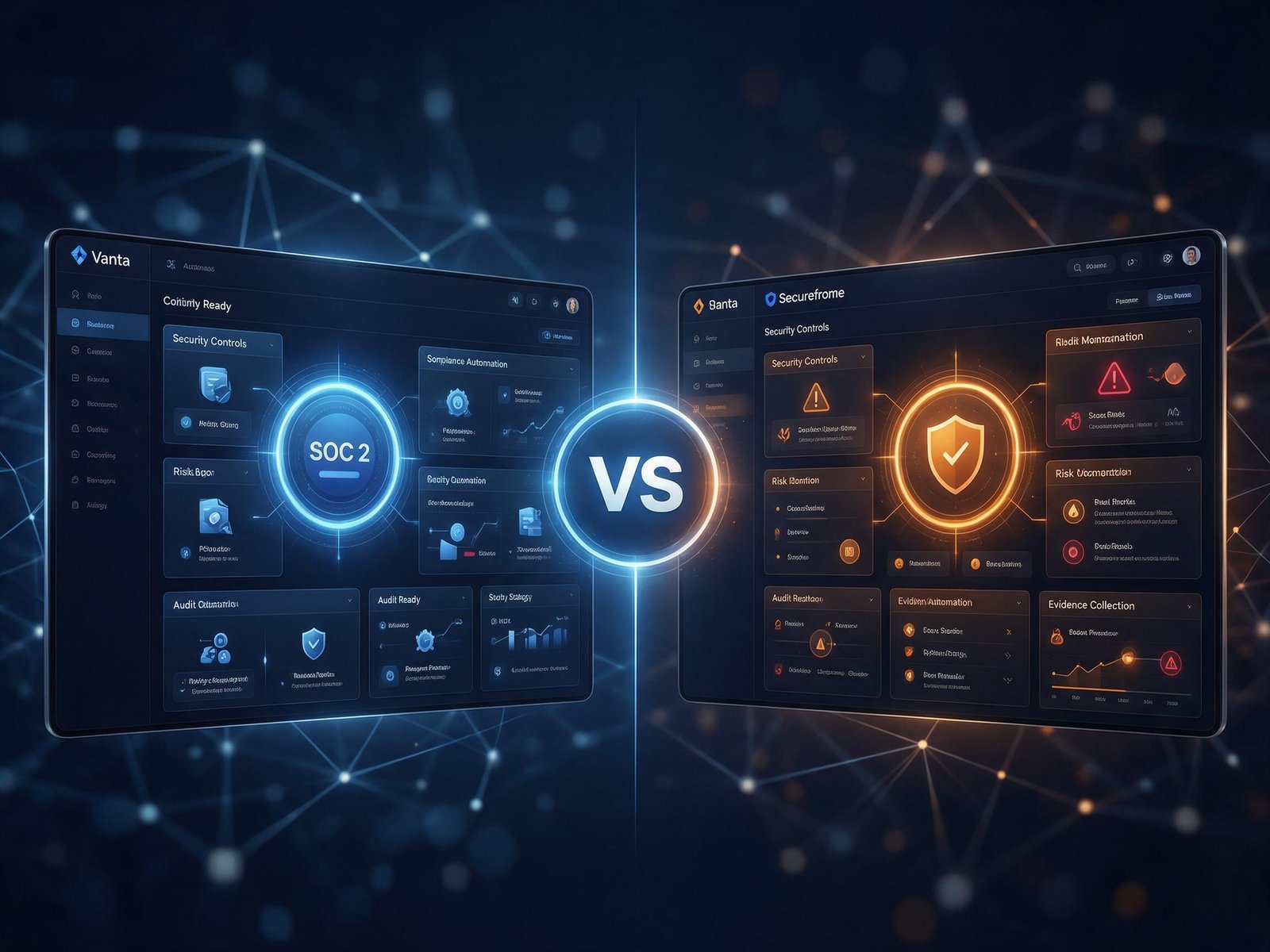
The next question is always a financial one: will you throw money at an AI-powered compliance platform (like Vanta or Drata) and do the work yourself, or will you hire a consultant to help you through the process? Either way, you’re going to have to get an auditor’s signature on the final report, just a different type of investment. The truth in 2026 is that it’s not about software versus consultants, but rather understanding four distinct costs and choosing the mix of expertise and investment you’re comfortable with.

Table of Contents
What “SOC 2 for Startups” Actually Costs in 2026 (The Full Breakdown)
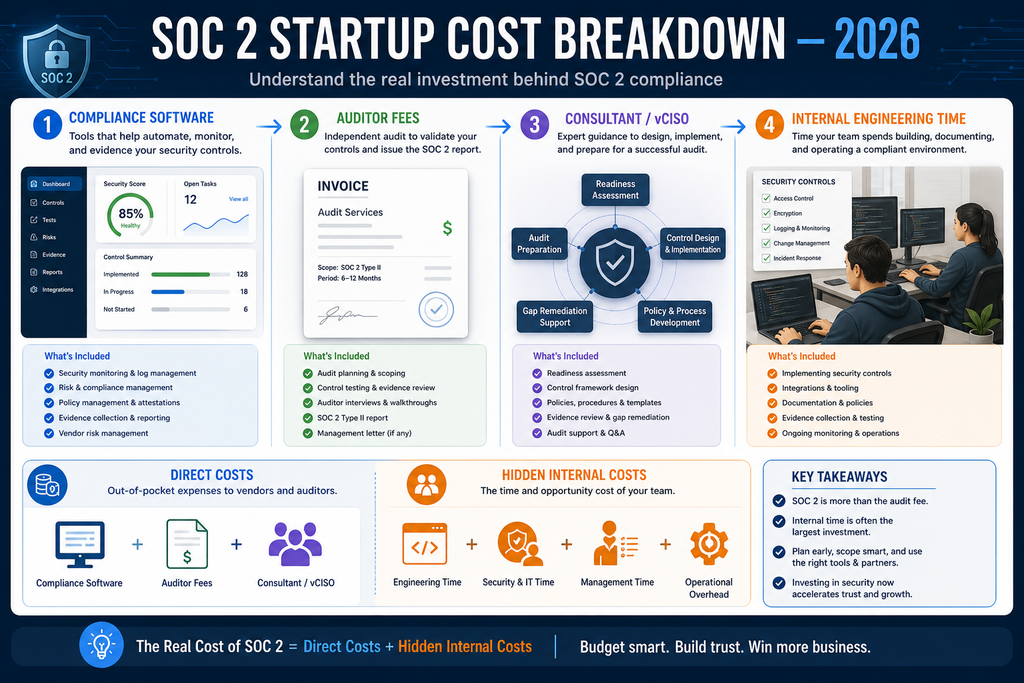
Here’s the mistake almost every first-time founder makes: they think SOC 2 is a single line item purchase — “buy the software, get the certificate.” It’s four, stacked: software/platform fees, auditor fees, consultant fees, and internal engineering time (and skipping any one of them simply moves the cost around – onto your engineering team’s calendar).
Software/Platform Fees (Vanta, Drata, Sprinto, Secureframe)
Compliance automation platforms have become the default for most in their early years of ops, offering to automate the evidence collection, constantly watch their cloud infrastructure for drift, and map those controls automatically to the Trust Services Criteria.
Vanta: Roughly $8,000-18,000/year for SOC 2 alone on a plan, tending toward $20,000-30,000+ for SOC 2 + ISO 27001 + HIPAA coverage. Vanta is often the most aggressive on early-stage discounts and typically runs startups through accelerators like Y Combinator.
Drata: Similarly priced at $7,500-15,000/year but offers a leaner “Foundation” tier for smaller teams and has slightly more flexible contract terms in practice.
Secureframe: $7,000-20,000/year, often bundled with introductions to auditors and some hand-holding around the process.
Sprinto: The budget alternative at $5,000-10,000/year for most, and is the preferred choice when every dollar of runway matters.
Newer AI-first platforms (Screenata, ComplyJet, TrustCloud, etc): These tend to lean more on AI agents to generate policies, pull evidence, and prepare for auditor interviews with minimal manual curation, occasionally undercutting the “Big Four” in price, at $5,000-6,000/year.
None of the major players publish pricing, so all quotes are on an individual basis, with end-of-quarter negotiations often cutting $15,000-25,000 off a listed quote.
Auditor Fees (Type I vs. II)
Another cost centers people miss is separate from the software – your CPA (certified public accountant) firm who will ultimately report on and issue your SOC 2 report will be a separate invoice, as no platform vendor can issue an official SOC 2 opinion.
For a Type I (snapshot) report, expect $5,000-20,000, with many startup-friendly boutique firms at the lower end of that range.
Type II reports ($7,000-50,000+) are more involved, requiring 3-12 months’ worth of evidence collection from your team, so they tend to fall significantly on the higher end of this range. This range varies depending on the number of Trust Services Criteria being reported on, any additional regulations (HIPAA, ISO 27001, etc.), and whether you go with a Big Four name or a local CPA (often 50% cheaper for an identical report).
Consultant/vCISO Fees
Hiring a compliance consultant or fractional CISO to shepherd your organization through the process can carry additional costs, including:
Readiness engagement for Type I: $5,000-20,000
A full Type II retainer engagement (12 months): Can go up to $60,000-120,000 (at $8,000-10,000/month)
Consultants get their cut by translating much of the jargon and legwork for the auditor – they do custom policy writing, mock interviews with your team, find gaps the auditor might have missed, etc., so these costs can be significant if you’re not already resourced in this area.
The Hidden Cost: Internal Engineering Time
This is one most people don’t budget for, often determining the difference between the two paths described above. Someone on your team has to go and configure MFA, set up audit logging, conduct access reviews, and answer the platform’s questions for evidence collection. At a loaded rate of $150/hour for an engineer:
DIY on a platform alone: ~80 hours ($12,000)
Platform + consultant hybrid: ~40 hours ($6,000), with the busywork taken over by the consultant
AI-agent-assisted: As little as 10-20 hours ($1,500-3,000) – much of it automated by the platform’s AI agents
AI Compliance Platforms vs. Human Consultants: Head-to-Head Comparison
How AI-First Platforms Work
Modern compliance management software, be it an established name like Vanta or Drata or an emergent AI-native entrant, attaches directly to your AWS, GitHub, HR system, and identity provider to continuously ingest evidence of your controls’ effectiveness. The latest breed of tools goes further, utilizing AI to author your security policies, flag relevant gaps in natural language, and even simulate auditor conversations for SOC 2 readiness. Thus automated compliance management tools earn their keep – the process of getting ready for an audit that would previously take a team of people six months to perform can be largely automated and turned into a background process, with nudges when action is required.
What a Human Consultant Brings That Software Can’t
While software can be programmed to perform repetitive, rote tasks, there are critical areas where SOC 2 readiness requires human judgment:
- Scoping decisions, including which Trust Services Criteria are relevant to your customer contracts
- Prioritizing risks and remediations, including what needs to happen for audit-readiness versus what can wait
- Negotiating with auditors (many consultants have pre-existing relationships with firms that can expedite scheduling and communication)
- Translating “auditor speak” into actionable items, particularly around what specific evidence an auditor will want to see
A human consultant serves as a layer of quality control and negotiation that an AI-enhanced GRC platform cannot provide.
Side-by-Side Cost Comparison Table
| Approach | Platform Cost | Consultant Cost | Auditor Fee | Engineering Time | Year-1 Total (Cash + Time) |
|---|---|---|---|---|---|
| AI platform only (DIY) | $5,000–$25,000 | $0 | $5,000–$10,000 | ~80 hrs ($12,000) | $29,000–$47,000 |
| AI platform + consultant hybrid | $12,000–$25,000 | $5,000–$20,000 | $5,000–$10,000 | ~40 hrs ($6,000) | $28,000–$61,000 |
| Full-service consultant-led | $0–$12,000 | $15,000–$40,000+ | $7,000–$45,000 | Minimal | $30,000–$90,000+ |
*Note: figures reflect a sub-50-employee SaaS startup pursuing Security-criteria SOC 2 Type I or Type II in 2026. *
Which Option Actually Costs Less? Three Real-World Startup Scenarios
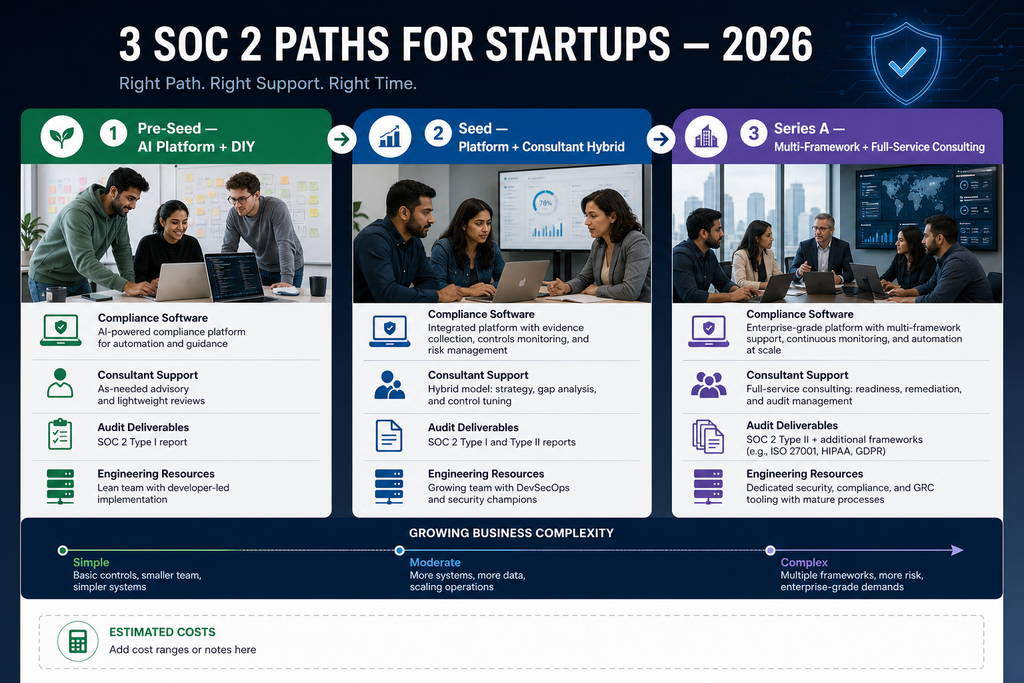
Scenario 1 — Pre-Seed, DIY with an AI Platform Only
A five-person team with clean, simple infrastructure can rely primarily on a low-cost AI compliance platform plus a boutique auditor to achieve SOC 2. Founders or engineers accept the burden of the readiness work and save the most money — between $15,000–30,000. But this approach requires actual time investment: 60–80 hours of configuration by code ninjas in the basement.
Scenario 2 — Seed Stage, Platform + Consultant Hybrid
At the seed stage, most startups that have raised a round and have customers relying on the SOC 2 report opt for a hybrid approach: keep the low-cost platform for the 80% of the work that can be automated, but outsource the complex, bespoke 20% (policy writing, remediation, interview prep) to a consultant or vCISO. This approach is more expensive ($28,000–61,000) but can save 40+ hours of engineering time that would have been burned on compliance.
Scenario 3 — Series A, Multi-Framework with Full-Service Consulting
When a company needs to complete SOC 2, ISO 27001, and HIPAA, the complexity increases dramatically, and a full-service consulting approach — for all three frameworks at $30,000–90,000+ — can actually be cheaper than trying to spread the cost of expensive senior-level engineers across these verticals.
How to Choose the Right Path for Your Startup (Decision Framework)
When AI Compliance Software Wins
- You have a technically strong founding team comfortable configuring cloud security settings
- Your infrastructure is simple (single cloud provider, standard SaaS stack)
- You’re pursuing a single framework (SOC 2 only, Security criteria)
- Runway is tight and every dollar matters
When a Consultant Is Worth the Extra Spend
- You’re pursuing multiple frameworks simultaneously
- Your team has zero bandwidth for 60–80 hours of readiness work
- You need help negotiating auditor timelines or scope
- Your infrastructure is complex, legacy, or spans multiple environments
Red Flags That Signal You’re Overpaying
- A platform quote with no visible negotiation room (always push — 15–25% discounts are standard)
- A consultant retainer with no defined end date or deliverable milestones
- An auditor quote significantly above $50,000 for a straightforward, under-50-employee SOC 2 Type II
- Any vendor bundling “unlimited support” without clarifying what’s actually included
Conclusion
There are no clear winners in the debate about SOC 2 — the reality is that most startups benefit from a hybrid approach of AI-compliance platform + select consulting hours in areas requiring judgement. The temptation to think of SOC 2 as a single software purchase is what creates the “Why am I being billed $90,000?” problem to begin with. Founders should think of SOC 2 as four expenses – platform, auditor, consultant, and internal time – and aggressively bargain hunt in all four categories.
FAQs
1. Is SOC 2 something we have to do as a startup or is it just a nice-to-have?
SOC 2 is not technically required by law, but it’s become a critical business enabler for B2B SaaS companies that sell to mid-market or enterprise organizations, since most procurement teams will literally not sign an contract without it.
2. Can I make someone from my team who isn’t a consultant do it?
Yes, many pre-seed and seed-stage startups have successfully done a SOC 2 Type I on an AI compliance platform + independent auditor without a consultant, for about 60-80 hours of engineering work that a consultant might bill for 2-3x as much.
3. Is there a big difference between type I and type II, and which is right for us?
Type I is simply a snapshot assertion at a point in time about whether controls are “suitably designed”, while type II goes into “operating effectiveness” over a 3-12 month period. Most startups will do a type I first to get it off the table, and then move onto type II if/when enterprise sales folks ask them.
4. Are Vanta, Drata, Sprinto, Secureframe etc. are all similar offerings or are there meaningful differences?
They’re all similar in terms of their fundamental value proposition, but differ in terms of degree of integration depth, auditor partnerships and price points. Vanta and Drata have the broadest integration ecosystems and auditor partnerships, while Sprinto tends to be the cheapest option for small teams, and Secureframe often includes the most advisory services in their offering.
5. Why does it feel like you can spend anywhere from $5,000 to $50,000 on the exact same audit?
Teams tend to pay anywhere from 3-10x more for the exact same SOC 2 depending on the auditor, the number of Trust Services Criteria they want to include, whether they do type I or type II, how long the observation window is, and the brand reputation of the accounting firm.
6. Does an automated compliance platform take away all the work for engineers?
Not really, most platforms require someone on your team to configure, respond to auditor evidence requests, and remediate any issues found during the audit, though that’s significantly streamlined compared to a manual process.
7. What’s a reasonable budget for a lean pre-seed startup to be SOC 2 compliant in 2026?
If you’re a small SaaS company with a lean engineering team doing a SOC 2 type I audit it’s going to be on the order of $15,000-$30,000 for a audit platform + audit + engineering time as of 2026.